Author: aks0911

  • Vectorization and Functional Design in Data Science

    Writing Reusable Logic and Scaling Computation in Python

    As analytics problems grow in complexity, two ideas become essential for writing clean and efficient code: functions and vectorization. Functions help you organize and reuse logic. Vectorization helps you apply that logic efficiently to entire datasets. Together, they shift your mindset from writing scripts to building computational systems.

    In this page, we move from basic Python constructs toward analytical programming discipline—where performance, abstraction, and scalability matter.


    Functions as Analytical Abstractions

    At its core, a function is a reusable block of logic. But in analytics, functions are more than a convenience—they are the primary way we formalize transformations.

    Consider a simple mathematical relationship such as a linear model:

    Linear Function Visualizer

    Slope (m): 1

    Intercept (b): 0

    This equation defines a transformation: given an input ( x ), we compute an output ( y ). In programming terms, this relationship becomes a function.

    Instead of rewriting the formula repeatedly, we encapsulate it:

    def linear_model(x, m, b):
        return m * x + b
    

    The function now represents a reusable computational rule. In analytics workflows, this pattern appears everywhere:

    • Data normalization functions
    • Feature engineering transformations
    • Custom evaluation metrics
    • Business rule calculations
    • Data cleaning pipelines

    Functions allow you to treat logic as a modular component rather than scattered instructions.


    Parameters, Return Values, and Generalization

    A well-designed function does not depend on global variables or hardcoded values. It receives inputs (parameters), processes them, and returns outputs.

    This separation is crucial in analytics because:

    1. It makes experiments reproducible.
    2. It enables testing.
    3. It allows automation across datasets.

    For example, suppose you want to standardize a numeric feature using the z-score transformation:

    \[
    z = \frac{x - \mu}{\sigma}
    \]

    We can express this computational rule using a function:

    def standardize(x, mean, std):
        return (x - mean) / std
    

    The function is abstract—it works for any dataset once the appropriate parameters are supplied. In practice, you would compute the mean and standard deviation from training data and apply the same transformation to validation data.

    This pattern—compute parameters, then apply transformation—is foundational in machine learning pipelines.


    Scope and Purity

    Understanding scope is essential when writing analytical functions. Variables created inside a function exist only within that function. This isolation prevents accidental interference between computations.

    In analytics, side effects (unexpected changes in external variables) can introduce subtle bugs. Therefore, writing pure functions—functions that depend only on inputs and return outputs without modifying external state—is considered best practice.

    A pure function improves:

    • Debugging clarity
    • Reproducibility
    • Parallelization potential
    • Unit testing feasibility

    As analytical systems scale, this discipline becomes non-negotiable.


    Functions as First-Class Objects

    In Python, functions are first-class objects. This means they can be:

    • Assigned to variables
    • Passed as arguments
    • Returned from other functions

    This capability enables higher-order programming. For instance, we can define a function that applies another function to data:

    def apply_transformation(data, func):
        return func(data)
    

    Now any transformation function can be passed into this structure.

    This is conceptually important in analytics because many libraries operate this way. For example, optimization routines accept objective functions. Machine learning frameworks accept loss functions. Data processing frameworks apply transformation functions across partitions.

    Understanding this abstraction prepares you for more advanced analytical tooling.


    Lambda Functions and Concise Transformations

    Sometimes we need lightweight functions for temporary use. Lambda expressions allow inline function definitions:

    square = lambda x: x**2
    

    This is particularly useful in data manipulation operations where transformation logic is simple and local.

    However, for complex analytics workflows, explicit named functions are preferable for readability and maintainability.


    The Computational Limitation of Loops

    When working with small datasets, looping over elements is straightforward:

    result = []
    for value in data:
        result.append(value * 2)
    

    However, this approach does not scale well. As datasets grow to millions of rows, Python-level loops become inefficient due to interpreter overhead.

    This is where vectorization becomes transformative.


    What Is Vectorization?

    Vectorization means applying an operation to an entire array or dataset at once, rather than iterating element by element in Python.

    Instead of writing:

    result = []
    for x in data:
        result.append(2 * x)
    

    We use:

    result = 2 * data
    

    If data is a NumPy array or Pandas Series, this computation is executed in optimized C-level code, making it dramatically faster.

    Vectorization is not just syntactic convenience—it is a computational optimization strategy.


    Why Vectorization Is Faster

    There are three major reasons vectorized operations outperform loops:

    1. Compiled backend execution – Libraries like NumPy use optimized C implementations.
    2. Reduced interpreter overhead – Python does not evaluate each element individually.
    3. Memory efficiency – Vectorized operations leverage contiguous memory blocks.

    In large-scale analytics, performance gains can be orders of magnitude.


    Vectorization with NumPy

    Suppose we want to compute the quadratic transformation:

    f(x) = 1x² + 0x + 0

    a = 1

    b = 0

    c = 0

    \[
    f(x) = ax^2 + bx + c
    \]

    Using loops, we would compute this value for each element. With vectorization:

    import numpy as np
    
    x = np.array([1, 2, 3, 4])
    a, b, c = 2, 3, 1
    
    result = a * x**2 + b * x + c
    

    The expression applies to the entire array simultaneously.

    This is the foundation of numerical computing in Python.


    Broadcasting: Implicit Vector Expansion

    Broadcasting is a powerful feature that allows operations between arrays of different shapes, provided they are compatible.

    For example:

    x = np.array([1, 2, 3])
    x + 5
    

    Here, the scalar 5 is automatically “broadcast” across all elements.

    This concept extends to multidimensional arrays and forms the backbone of matrix operations in machine learning.


    Vectorization in Pandas

    Pandas builds on NumPy and extends vectorized operations to tabular data.

    Instead of:

    df["new_column"] = df["old_column"].apply(lambda x: x * 2)
    

    We prefer:

    df["new_column"] = df["old_column"] * 2
    

    The second approach is faster and more idiomatic.

    In general, avoid .apply() for element-wise arithmetic if a vectorized expression exists.


    Vectorized Conditional Logic

    Conditional transformations can also be vectorized.

    Using NumPy:

    import numpy as np
    np.where(x > 0, x, 0)
    

    This replaces negative values with zero in a fully vectorized manner.

    Using Pandas:

    df["flag"] = df["sales"] > 1000
    

    This creates a Boolean column efficiently without explicit loops.

    Vectorized conditionals are central to feature engineering pipelines.


    Mathematical Thinking in Vectorized Systems

    Many analytical transformations can be represented as vector operations. For instance, normalization, scaling, polynomial expansion, and aggregation all map naturally to vectorized computation.

    Consider the Pythagorean relationship:

    Pythagorean Theorem

    a² + b² = c²

    a: 3

    b: 4

    a² + b² =

    c = √(a² + b²) ≈

    c² ≈

    In a vectorized environment, we could compute distances across entire arrays of coordinates simultaneously rather than processing each point individually.

    This approach transforms how we conceptualize computation: instead of “for each row,” we think “for the entire column.”


    When Not to Vectorize

    Despite its advantages, vectorization is not always the solution. It may not be suitable when:

    • The logic depends on sequential state changes.
    • Operations require complex branching.
    • Memory constraints prevent large intermediate arrays.

    In such cases, optimized loops, list comprehensions, or specialized libraries may be preferable.

    Understanding trade-offs is part of computational maturity.


    Functions + Vectorization = Scalable Pipelines

    The most powerful pattern in analytics combines both concepts.

    You define reusable transformation functions and apply them in a vectorized manner to datasets.

    For example:

    def scale_column(series):
        return (series - series.mean()) / series.std()
    
    df["scaled_feature"] = scale_column(df["feature"])
    

    Here:

    • The function encapsulates logic.
    • The operation executes vectorized.
    • The pipeline remains readable and scalable.

    This pattern generalizes to feature engineering modules, preprocessing layers, and modeling workflows.

    Performance Mindset in Analytics

    At beginner levels, correctness is enough. At intermediate levels, readability matters. At advanced levels, performance and abstraction dominate.

    Functions provide abstraction.
    Vectorization provides performance.

    Mastering both moves you from writing scripts to designing systems

    Conceptual Transition

    By understanding functions, you learn to structure computation.
    By understanding vectorization, you learn to scale computation.

    Together, they enable:

    • Efficient feature engineering
    • High-performance numerical computation
    • Clean, modular data pipelines
    • Production-ready analytical systems

    This marks a shift from “coding for small exercises” to “engineering analytical workflows.”


    Next Page Preview

    In the next section, we will build on these ideas by exploring NumPy fundamentals and array mathematics in depth—where vectorization becomes not just a technique but the default computational paradigm.

    Understanding arrays at a structural level will deepen your grasp of how Python achieves high-performance numerical computing and will prepare you for advanced statistical and machine learning operations.
  • Python Foundations for Data Analytics

    A Practical Programming Foundation for Data Analysis

    Python has become the dominant programming language in modern analytics—not because it is the most complex or the most mathematically sophisticated, but because it strikes a powerful balance between readability, flexibility, and computational capability. For students entering the world of data analysis, learning Python is less about becoming a software engineer and more about acquiring a precise, expressive tool for thinking with data.

    This page is designed to build your foundation in Python specifically for analytics. The focus is not on advanced software architecture or application development. Instead, we concentrate on the core programming concepts you will repeatedly use when cleaning datasets, transforming variables, computing metrics, and preparing data for modeling.

    By the end of this lesson, you should understand how Python operates at a structural level and how its fundamental concepts connect directly to analytical workflows.


    Why Python Is Central to Modern Analytics

    Before diving into syntax, it is important to understand why Python is so widely adopted in analytics environments.

    Python offers several characteristics that make it ideal for data work:

    • Readable syntax that resembles plain English.
    • Extensive ecosystem of libraries for statistics, visualization, and machine learning.
    • Strong community support and continuous development.
    • Interoperability with databases, cloud systems, and APIs.
    • Scalability from small scripts to production systems.

    In practical terms, Python allows analysts to:

    • Load and manipulate large datasets.
    • Perform statistical analysis.
    • Create reproducible workflows.
    • Visualize patterns and distributions.
    • Build predictive models.

    When working in environments such as Jupyter Notebook, Python becomes an interactive analytical workspace where code, output, and explanations coexist in a structured manner.


    Variables and Data Types in an Analytical Context

    At its core, Python revolves around variables—named containers that store data values. In analytics, variables often represent real-world measurements such as revenue, age, temperature, category labels, or timestamps.

    Core Data Types You Must Master

    While Python supports many data types, analytics primarily relies on the following:

    • Integers (int) – Whole numbers (e.g., 10, 42, -3)
    • Floats (float) – Decimal numbers (e.g., 3.14, 99.9)
    • Strings (str) – Text values (e.g., “January”, “Customer_A”)
    • Booleans (bool) – Logical values (TrueFalse)

    Understanding data types is critical because operations depend on them. For example:

    • Mathematical operations apply to integers and floats.
    • Concatenation applies to strings.
    • Logical filtering relies on boolean expressions.

    A common beginner mistake in analytics is failing to recognize mismatched types—such as treating numeric data stored as text. Being deliberate about data types prevents subtle computational errors.


    Core Data Structures for Analytics

    In real datasets, you rarely work with single values. You work with collections of values. Python provides built-in data structures that form the foundation for handling structured data.

    Lists

    Lists are ordered collections of values and are extremely common in analytics.

    They are useful for:

    • Storing sequences of measurements.
    • Collecting results of computations.
    • Iterating over multiple values.

    Example use cases:

    • Daily sales values.
    • Temperature readings.
    • User counts over time.

    Tuples

    Tuples are similar to lists but immutable (cannot be modified after creation). They are often used when values should remain constant.

    Common analytical use:

    • Representing coordinates (x, y).
    • Returning multiple outputs from a function.

    Dictionaries

    Dictionaries store data as key–value pairs. This structure is powerful for representing structured records.

    Example:

    • {“name”: “Alice”, “age”: 30}
    • {“product”: “Laptop”, “price”: 1200}

    Dictionaries are conceptually important because they mirror how tabular data organizes information—each field (column) corresponds to a labeled key.

    Sets

    Sets store unique values and are useful for:

    • Removing duplicates.
    • Performing intersection and union operations.
    • Identifying distinct categories.

    Mastery of these structures prepares you for higher-level tools like pandas DataFrames.


    Operators and Expressions

    Operators allow you to perform calculations and comparisons.

    Arithmetic Operators

    • Addition (+)
    • Subtraction (-)
    • Multiplication (*)
    • Division (/)
    • Floor division (//)
    • Exponentiation (**)
    • Modulus (%)

    These are used for:

    • Computing averages.
    • Calculating growth rates.
    • Normalizing values.

    Comparison Operators

    • Equal to (==)
    • Not equal (!=)
    • Greater than (>)
    • Less than (<)
    • Greater than or equal (>=)
    • Less than or equal (<=)

    These operators produce boolean values and are foundational for filtering and conditional logic.

    Logical Operators

    • and
    • or
    • not

    Logical operators allow compound conditions such as filtering rows where revenue > 1000 and region == “North”.

    Understanding these operators deeply enables expressive analytical queries.


    Conditional Logic and Decision Structures

    In analytics, decision rules are everywhere. You often need to classify values based on thresholds or categories.

    Python provides conditional statements using ifelif, and else.

    Applications in analytics include:

    • Categorizing performance levels.
    • Flagging anomalies.
    • Assigning labels based on criteria.

    Example conceptual logic:

    • If revenue > 10,000 → classify as “High”
    • Else → classify as “Standard”

    This conditional thinking is fundamental in feature engineering and rule-based systems.


    Iteration: Automating Repetitive Tasks

    Real datasets contain thousands or millions of records. Manually processing each value is impossible.

    Python supports repetition through:

    • for loops
    • while loops

    For Loops

    Used when iterating over:

    • Lists
    • Dictionaries
    • Ranges of numbers

    Example analytical applications:

    • Computing total revenue.
    • Transforming values.
    • Aggregating statistics.

    While Loops

    Used when repetition continues until a condition is met.

    Though loops are powerful, modern analytics often favors vectorized operations through libraries like pandas and NumPy for efficiency. However, understanding loops builds the mental model required for advanced techniques.


    Functions: Writing Reusable Analytical Logic

    Functions allow you to encapsulate logic into reusable blocks.

    Why functions matter in analytics:

    • Prevent code repetition.
    • Improve readability.
    • Support modular design.
    • Enhance reproducibility.

    A well-written analytical script often consists of multiple small functions, each responsible for one clear task.

    For example:

    • A function to calculate growth rate.
    • A function to clean text.
    • A function to normalize numerical columns.

    Functions transform scattered scripts into structured analytical pipelines.


    Error Handling and Debugging

    Data rarely behaves perfectly. Files may be missing, values may be null, and formats may be inconsistent.

    Python provides structured error handling using:

    • try
    • except
    • finally

    This allows your code to handle unexpected situations gracefully.

    Example applications:

    • Skipping corrupted rows.
    • Handling missing files.
    • Managing division by zero errors.

    Learning to interpret error messages is a core skill. Debugging is not a failure—it is a normal part of analytical work.


    Working with External Data

    Analytics rarely involves hard-coded values. Most work begins by importing data from external sources.

    Common formats include:

    • CSV files
    • Excel spreadsheets
    • JSON files
    • Databases

    Python provides tools for loading these formats, especially through pandas.

    Understanding file paths, directories, and relative vs absolute paths is part of becoming comfortable in an analytical environment.


    Introduction to NumPy and pandas

    While core Python builds your foundation, analytics becomes powerful when combined with libraries.

    NumPy

    NumPy enables:

    • Efficient numerical computation.
    • Multi-dimensional arrays.
    • Vectorized mathematical operations.

    It is the backbone of scientific computing in Python.

    pandas

    pandas introduces the DataFrame—a tabular structure similar to a spreadsheet or SQL table.

    With pandas, you can:

    • Filter rows.
    • Select columns.
    • Group data.
    • Compute aggregations.
    • Handle missing values.
    • Merge datasets.

    For analytics students, pandas becomes the primary working tool.


    Writing Clean and Readable Code

    Professional analytics requires more than correct outputs—it requires readable and maintainable code.

    Best practices include:

    • Meaningful variable names.
    • Clear function definitions.
    • Logical structuring.
    • Avoiding unnecessary complexity.
    • Adding comments where appropriate.

    Readable code supports collaboration and reproducibility.


    Reproducibility and Workflow Discipline

    Analytics is not just about obtaining insights; it is about being able to reproduce them.

    Python encourages reproducibility by:

    • Allowing scripts to be rerun.
    • Supporting version control.
    • Integrating with notebooks.
    • Enabling modular workflows.

    A disciplined workflow includes:

    • Clear data loading steps.
    • Transparent transformations.
    • Explicit calculations.
    • Organized output generation.

    This discipline distinguishes hobby coding from professional analytics.


    From Python Basics to Analytical Thinking

    Learning Python for analytics is not simply learning syntax. It is developing computational thinking.

    You learn to:

    • Break problems into smaller components.
    • Translate questions into logical conditions.
    • Structure repetitive processes efficiently.
    • Validate assumptions through code.

    Python becomes a language for reasoning about data.


    Common Beginner Mistakes to Avoid

    As you build your foundation, avoid these common pitfalls:

    • Ignoring data types.
    • Hardcoding values unnecessarily.
    • Writing overly complex logic.
    • Not checking intermediate outputs.
    • Neglecting readability.

    Awareness of these mistakes accelerates learning.


    Preparing for the Next Modules

    By mastering Python essentials, you prepare yourself for:

    • Exploratory Data Analysis (EDA)
    • Statistical modeling
    • Machine learning
    • Data visualization
    • Feature engineering
    • Deployment workflows

    The confidence gained here reduces cognitive load later when topics become mathematically or technically advanced.


    Conclusion

    Python Essentials for Analytics is not about memorizing syntax—it is about building a structured way of thinking with data. Variables, data types, loops, conditionals, and functions are not isolated programming topics. They are the building blocks of analytical reasoning.

    When you understand Python at this foundational level, libraries like pandas and NumPy stop feeling intimidating. Instead, they become logical extensions of concepts you already grasp.

    In the modules ahead, you will apply these fundamentals to real datasets, uncover patterns, build models, and interpret results. But everything begins here—with a clear understanding of how Python operates as the analytical engine behind modern data work.

    Next: Foundations of Data Structures in Python for Analytics

  • Foundations of Data Structures in Python for Analytics

    A Conceptual and Practical Foundation in Python

    Data structures are the architecture of analytical thinking in Python. Before visualization, before modeling, and even before statistical reasoning, there is a more fundamental question: 

    Types of Data

    How is the data organized in memory? The answer to this question determines how efficiently you can manipulate information, how clearly you can express logic, and how scalable your workflow becomes.

    In analytics, data structures are not abstract programming concepts. They directly influence how datasets are represented, transformed, and interpreted. When you clean a dataset, filter values, group categories, or compute aggregates, you are interacting with underlying structures that define how information is stored and retrieved.

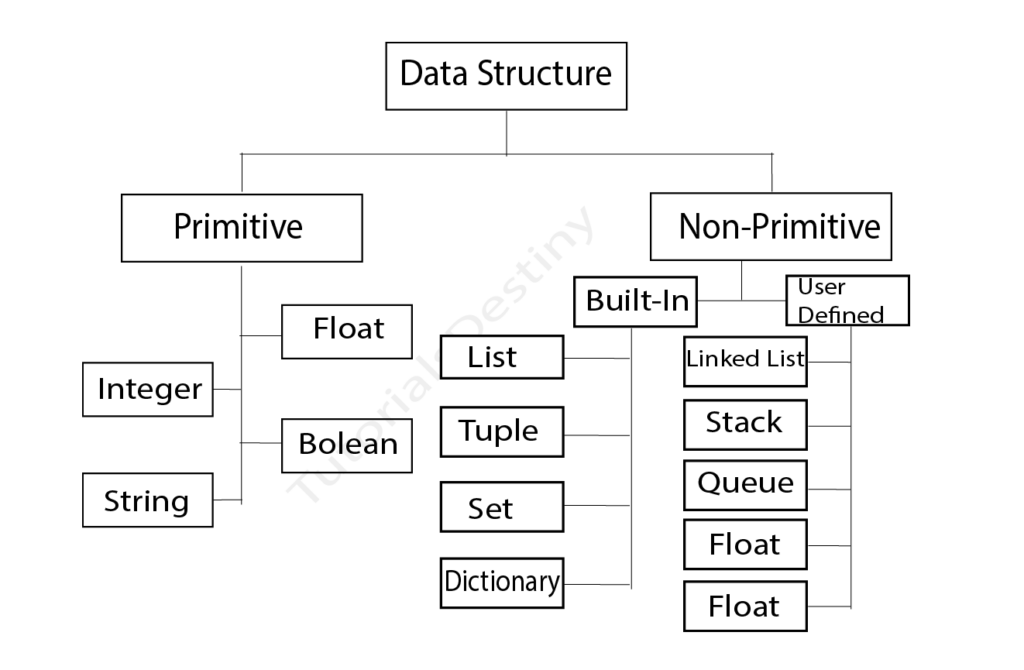
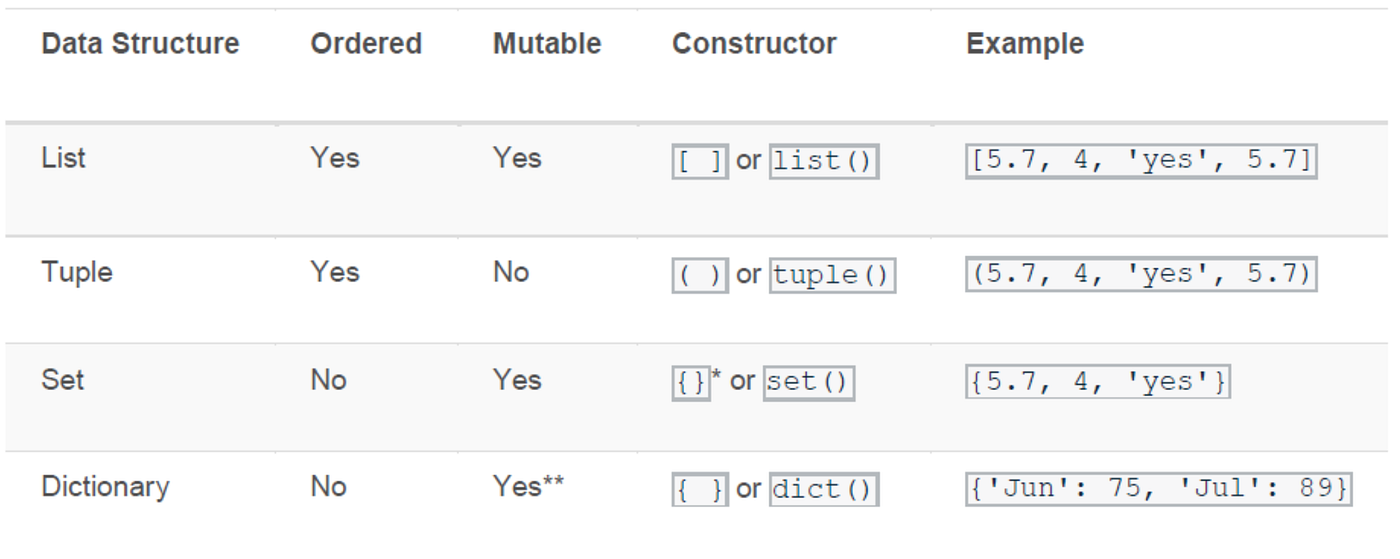
    This page develops a deep understanding of Python’s core data structures—lists, tuples, dictionaries, and sets—from an analytical perspective. The objective is not only to understand their mechanics, but to understand their strategic role in data work.


    The Role of Data Structures in Analytical Workflows

    Every dataset, regardless of size, must be represented internally in some structured format. Whether you are analyzing a small CSV file or working with large-scale machine learning pipelines, your analysis depends on how data is arranged.

    Image

    Data structures influence:

    • How easily you can access elements
    • How efficiently you can modify values
    • How clearly your logic maps to real-world meaning
    • How well your code scales

    Poor structural decisions lead to tangled logic and unnecessary complexity. Strong analytical programmers deliberately choose structures that align with the shape and purpose of their data.


    Lists: Ordered Collections for Sequential Data

    A list is an ordered, mutable collection of elements. It preserves sequence, which makes it naturally suited for representing time-based or position-based information.

    In analytics, lists frequently appear when dealing with:

    • Time series observations
    • Sequential measurements
    • Aggregated results from computations
    • Iterative transformations

    Because lists preserve order, they align well with real-world data that unfolds across time or follows a logical progression.

    One of the most important characteristics of lists is mutability. You can add, remove, or modify elements dynamically. This flexibility is useful when collecting values during iteration or building intermediate results during preprocessing.

    However, lists also have limitations. They do not enforce uniform data types, nor do they provide labeled access to elements. Access relies on positional indexing, which can reduce clarity when datasets grow complex.

    From an analytical standpoint, lists are often an initial container—a staging structure before data is converted into more structured forms like arrays or DataFrames.


    Tuples: Stability and Immutability

    Tuples resemble lists in that they are ordered collections. The crucial difference is that tuples are immutable. Once created, their contents cannot be altered.

    Immutability has conceptual importance in analytics. It signals that a collection represents a fixed logical unit. For example, a coordinate pair (latitude, longitude) or a configuration parameter set should not change during computation.

    Using tuples communicates intent: this data should remain stable. That stability can prevent accidental modification and reinforce logical clarity.

    Although tuples are less frequently used than lists in day-to-day analysis, they are essential in situations where data integrity is critical or when returning multiple values from functions.

    In practical terms, tuples support structured thinking by distinguishing between flexible collections and fixed entities.


    Dictionaries: Representing Structured Records

    Dictionaries are arguably the most analytically expressive of Python’s built-in structures. They store data as key–value pairs, allowing direct access through meaningful labels rather than numeric positions.

    This mirrors how structured data is conceptualized in real-world datasets. Consider a customer record:

    • Name
    • Age
    • Location
    • Purchase history

    In dictionary form, each attribute becomes a key mapped to its corresponding value. This labeled access dramatically improves clarity compared to positional indexing.

    Dictionaries are particularly powerful in analytics because they:

    • Provide fast lookups
    • Allow semantic labeling of data
    • Support nested structures
    • Align naturally with JSON and API responses

    Many modern data pipelines involve ingesting JSON data, which maps directly into dictionaries or lists of dictionaries. Understanding dictionaries is therefore foundational for real-world data integration.

    Nested dictionaries allow hierarchical representation, such as region → country → city → metrics. While powerful, nested structures require disciplined organization to avoid excessive complexity.

    In many ways, dictionaries form the conceptual bridge between raw Python structures and higher-level tabular systems.


    Sets: Managing Uniqueness and Comparison

    A set is an unordered collection of unique elements. Unlike lists, sets automatically eliminate duplicates.

    In analytics, uniqueness is often a central concern. You may need to identify distinct categories, remove duplicate identifiers, or compare overlapping groups.

    Sets excel in these scenarios because they support mathematical set operations such as:

    • Union (combining elements)
    • Intersection (common elements)
    • Difference (elements in one set but not another)

    These operations become valuable when comparing customer segments, product categories, or experiment groups.

    However, sets do not preserve order and do not allow indexed access. Their purpose is conceptual clarity around uniqueness and membership testing rather than sequential processing.


    Structural Thinking in Analytical Practice

    The choice of data structure is rarely random. It should reflect the analytical objective.

    If your task involves ordered observations, a list may be appropriate. If you require labeled attributes, a dictionary provides clarity. If uniqueness is central, a set becomes ideal. If stability is necessary, a tuple reinforces immutability.

    Strong analysts begin by asking: What is the logical structure of this data? Only then do they choose a container.

    This structural awareness reduces code complexity and improves interpretability.


    Iteration Across Structures

    In analytics, iteration allows you to apply logic across collections of values. Whether computing totals, transforming categories, or filtering based on conditions, iteration connects structure to computation.

    Lists and tuples are typically iterated sequentially. Dictionaries allow iteration over keys, values, or both. Sets can also be iterated, though without guaranteed order.

    Understanding iteration patterns enables you to:

    • Compute aggregates
    • Transform raw inputs
    • Apply classification rules
    • Validate data integrity

    Even when later transitioning to vectorized operations in pandas or NumPy, the mental model of iteration remains essential.


    Combining Data Structures

    Real analytical workflows rarely rely on a single structure. Instead, they involve combinations.

    For example, a dataset might initially appear as a list of dictionaries, where each dictionary represents a record. Alternatively, you may encounter a dictionary of lists, representing column-oriented storage.

    These combinations reflect different perspectives on the same dataset:

    • Row-oriented representation
    • Column-oriented representation

    Recognizing these perspectives prepares you for understanding tabular data systems.


    From Core Structures to Tabular Analytics

    Higher-level libraries like pandas build upon these fundamental ideas. A DataFrame can be conceptualized as a structured system combining labeled columns, indexed rows, and efficient storage mechanisms.

    When you understand Python data structures deeply, the transition to pandas feels natural rather than abrupt.

    You begin to see that:

    • Columns resemble structured sequences
    • Rows resemble dictionaries
    • Indexes provide labeled positioning

    The abstraction becomes understandable because the foundation is clear.


    Performance and Memory Awareness

    While beginners focus primarily on clarity, understanding performance considerations becomes increasingly important as datasets scale.

    Lists are dynamic and flexible but can become inefficient for heavy numerical computation. Dictionaries provide fast lookups but consume additional memory. Sets offer efficient uniqueness operations. Tuples are lightweight and stable.

    As your analytical projects grow in size, these differences influence execution speed and resource usage.

    Performance awareness does not mean premature optimization—it means understanding the structural trade-offs of each choice.


    Common Structural Pitfalls

    Analytical beginners often encounter recurring structural issues:

    • Using lists when labeled access is needed
    • Overcomplicating nested dictionaries
    • Forgetting that sets are unordered
    • Confusing positional indexing with semantic labeling

    These mistakes typically arise from insufficient structural planning. Taking time to design data representation before analysis prevents such errors.


    Data Structures as Cognitive Tools

    Ultimately, data structures are not just storage mechanisms. They shape how you conceptualize problems.

    When you use dictionaries, you think in terms of labeled attributes. When you use lists, you think in terms of sequences. When you use sets, you think in terms of membership and comparison.

    This alignment between structure and cognition strengthens analytical reasoning.


    Preparing for Advanced Applications

    Mastering data structures prepares you for:

    • Data cleaning and transformation
    • Feature engineering
    • Statistical computation
    • Machine learning pipelines
    • Scalable analytical systems

    Every advanced analytical workflow rests on the disciplined use of foundational structures.

    When learners struggle with pandas or machine learning libraries, the difficulty often stems not from the advanced tools themselves, but from a weak understanding of underlying structures.


    Conclusion

    Data structures are the structural grammar of analytical programming. They determine how information is organized, accessed, and transformed. Lists manage sequences. Tuples enforce stability. Dictionaries provide labeled structure. Sets ensure uniqueness.

    Learning them is not a programming formality—it is the beginning of disciplined analytical thinking.

    As you progress into more advanced topics, these structures will remain present—sometimes visible, sometimes abstracted. Mastering them now ensures clarity, efficiency, and confidence in every future analytical task.

  • Types of Data Problems in Analytics: Descriptive, Diagnostic, and Predictive Explained

    A Practical Guide to Framing Business Questions Correctly

    Before writing SQL queries, building dashboards, or training machine learning models, one critical step determines whether your analysis will succeed or fail:

    Correctly identifying the type of data problem you are solving.

    In real organizations, most analytics failures happen not because of poor coding or weak models—but because the wrong type of analysis was applied to the problem.

    This article will help you:

    • Understand the three core types of data problems
    • Recognize how businesses frame each type
    • Map problem types to appropriate techniques
    • Avoid common mistakes
    • Connect problem types to career roles

    Why Problem Framing Matters

    Suppose a manager asks:

    “Sales are down. Can we use machine learning to fix this?”

    Jumping directly to machine learning may be inappropriate.
    The real need might be:

    • A performance dashboard (descriptive)
    • Root cause investigation (diagnostic)
    • Forecasting demand (predictive)

    The type of problem determines:

    • The tools you use
    • The techniques you apply
    • The complexity required
    • The expected business impact

    Choosing the wrong category leads to wasted time and confusion.


    The Three Core Types of Data Problems

    All business data questions generally fall into one of three categories:

    1. Descriptive – What happened?
    2. Diagnostic – Why did it happen?
    3. Predictive – What will happen next?

    Some frameworks include a fourth category—Prescriptive—but for foundational analytics, mastering these three is essential.


    Descriptive Data Problems

    “What Happened?”

    Descriptive problems focus on summarizing historical data.

    Core Objective

    Provide visibility into performance.

    Typical Business Questions

    • What were last month’s sales?
    • How many active users do we have?
    • What is the average order value?
    • What is our churn rate?

    Characteristics

    • Uses historical data
    • Focused on aggregation and reporting
    • Often recurring (daily, weekly, monthly reports)
    • Low algorithmic complexity

    Common Techniques

    • SQL aggregations
    • Group-by operations
    • Summary statistics
    • Data visualization
    • KPI dashboards

    Example: E-commerce Company

    The company tracks:

    • Daily revenue
    • Conversion rate
    • Cart abandonment rate
    • Revenue by region

    A dashboard answers:

    • Are we growing?
    • Which category performs best?
    • Which region underperforms?

    No machine learning required.

    Tools Typically Used

    • SQL
    • pandas
    • Excel
    • Tableau / Power BI
    • Plotly / Streamlit

    When Descriptive Is Enough

    Many companies operate successfully with strong descriptive analytics.

    If the goal is:

    • Monitoring
    • Reporting
    • Executive communication

    Then descriptive analysis is sufficient.

    Advanced modeling is not always necessary.


    Diagnostic Data Problems

    “Why Did It Happen?”

    Diagnostic problems go deeper.

    They investigate causes and drivers behind observed outcomes.

    Core Objective

    Explain patterns and identify influencing factors.

    Typical Business Questions

    • Why did churn increase last quarter?
    • Why did campaign A outperform campaign B?
    • Why are certain customers more profitable?
    • Why are support tickets rising?

    Characteristics

    • Focuses on comparison and segmentation
    • Identifies correlations
    • Often exploratory
    • More complex than descriptive

    Common Techniques

    • Segmentation analysis
    • Cohort analysis
    • Funnel analysis
    • Correlation matrices
    • Hypothesis testing
    • A/B test analysis

    Example: Subscription Platform

    Observation (Descriptive):

    • Churn increased by 6%.

    Diagnostic Analysis Reveals:

    • Users who skip onboarding churn at 3× higher rate.
    • Customers in Tier 1 pricing churn more.
    • Churn spikes after week 3.

    The business can now act.


    Important Distinction: Correlation vs Causation

    Diagnostic analysis often uncovers correlations.

    However:

    • Not all correlations imply causation.
    • A/B testing is required to confirm causal relationships.

    Understanding this distinction is critical for professional analysts.


    5. Predictive Data Problems

    “What Will Happen?”

    Predictive problems estimate future outcomes using historical data.

    Core Objective

    Forecast or classify future events.

    Typical Business Questions

    • Which customers are likely to churn?
    • What will next month’s sales be?
    • Which leads are most likely to convert?
    • What is the probability of loan default?

    Characteristics

    • Uses historical labeled data
    • Requires model training
    • Involves validation
    • Evaluated using performance metrics

    Common Techniques

    • Regression models
    • Classification algorithms
    • Time series forecasting
    • Machine learning pipelines

    Example: Retail Demand Forecasting

    The company predicts:

    • Weekly product demand
    • Seasonal spikes
    • Inventory requirements

    Even simple linear regression or moving averages may work effectively.


    Important Reality

    Most business predictive problems use:

    • Logistic regression
    • Random forests
    • Gradient boosting

    Not deep neural networks.

    Complexity is not always equal to value.


    Comparing the Three Problem Types

    FeatureDescriptiveDiagnosticPredictive
    Time OrientationPastPastFuture
    Core QuestionWhat happened?Why did it happen?What will happen?
    ComplexityLowMediumMedium–High
    ToolsSQL, dashboardsEDA, statisticsML models
    OutputReportsInsightsPredictions

    Real-World Scenario Walkthrough

    Let’s walk through a full example.

    Scenario: Revenue Decline

    Step 1: Descriptive

    • Revenue dropped 8% last quarter.
    • Region A declined most.

    Step 2: Diagnostic

    • Customer churn increased in Region A.
    • Price sensitivity higher among younger segment.
    • Marketing spend decreased in that region.

    Step 3: Predictive

    • Build churn model.
    • Identify high-risk customers.
    • Target retention campaigns.

    Notice the progression.

    You do not jump directly to predictive modeling.

    You move logically from:
    Descriptive → Diagnostic → Predictive.


    Common Mistakes in Problem Classification

    Mistake 1: Overusing Machine Learning

    Not every problem requires prediction.

    If leadership asks:

    “How did we perform last quarter?”

    You do not need a neural network.


    Mistake 2: Skipping Diagnostic Analysis

    Jumping to prediction without understanding drivers leads to:

    • Weak features
    • Poor model performance
    • Misaligned business strategy

    Mistake 3: Confusing Forecasting with Explanation

    A model may predict churn accurately but not explain why.

    Explanation and prediction are different goals.


    How Problem Types Align with Career Roles

    Data Analyst

    Primarily works on:

    • Descriptive
    • Diagnostic

    Data Scientist

    Primarily works on:

    • Predictive
    • Advanced diagnostic modeling

    ML Engineer

    Focuses on:

    • Deploying predictive systems

    Understanding problem types helps you choose your career path strategically.


    When Prescriptive Problems Appear

    While not core to this foundational topic, advanced organizations also tackle:

    Prescriptive problems:

    • What should we do?
    • How should we allocate budget?
    • What price should we set?

    These often involve:

    • Optimization
    • Simulation
    • Decision systems

    But prescriptive analytics builds on predictive foundations.


    Maturity Levels in Companies

    Early-Stage Companies

    Mostly descriptive.

    Growing Companies

    Strong diagnostic analysis.

    Mature Data-Driven Organizations

    Heavy predictive modeling.

    However, even advanced companies rely heavily on descriptive dashboards.


    How to Identify the Right Problem Type

    Ask:

    1. Is the question about the past or future?
    2. Does the business need explanation or forecasting?
    3. Is there historical labeled data?
    4. What decision will be made?

    If the answer involves:

    • Monitoring → Descriptive
    • Understanding causes → Diagnostic
    • Estimating outcomes → Predictive

    Practical Advice for Learners

    Before coding, always write:

    • The business question
    • The problem type
    • The intended outcome
    • The evaluation metric

    This discipline separates beginners from professionals.


    Why This Topic Is Foundational

    Many data professionals fail interviews not because they lack coding ability—but because they misframe problems.

    Employers look for:

    • Structured thinking
    • Business alignment
    • Appropriate method selection

    Mastering problem classification ensures:

    • Efficient workflows
    • Reduced overengineering
    • Higher impact projects

    Final Takeaways

    Every data project begins with a question.

    That question must be categorized correctly:

    • Descriptive → What happened?
    • Diagnostic → Why did it happen?
    • Predictive → What will happen?

    The smartest analysts are not the ones who use the most advanced models.

    They are the ones who:

    • Ask the right type of question
    • Choose the right method
    • Deliver actionable insights

    Here is a more educational, learner-focused version of the next-page paragraph, with business language removed and emphasis placed on learning and skill-building:


    👉 Next Page: Python Essentials for Analytics

    In the next section, you’ll start building a strong foundation in Python for data analysis. This lesson focuses on the Python concepts and programming practices most commonly used in analytics, such as working with data structures, writing clear and efficient code, and preparing data for exploration.

  • CRISP-DM & the Real-World Analytics Lifecycle

    A Practical Framework for Structuring Real-World Data Projects

    One of the biggest misconceptions in data science is that projects begin with modeling. In reality, successful analytics initiatives start long before any algorithm is trained. They begin with business understanding, structured planning, and iterative validation.

    This is where CRISP-DM (Cross-Industry Standard Process for Data Mining) becomes essential.

    CRISP-DM is not just a theoretical model—it is one of the most widely adopted frameworks for managing analytics and data science projects across industries. Even when companies do not explicitly mention it, their workflows often mirror its structure.

    In this article, you will learn:

    • What CRISP-DM is and why it matters
    • The six phases of CRISP-DM
    • How it maps to modern analytics lifecycles
    • How companies actually implement it
    • Common pitfalls
    • How this framework applies to your projects

    What is CRISP-DM?

    CRISP-DM stands for Cross-Industry Standard Process for Data Mining. It was developed in the late 1990s by a consortium including companies such as IBM, Daimler-Benz, and NCR Corporation.

    Despite being created decades ago, it remains relevant because it emphasizes:

    • Business-first thinking
    • Iterative development
    • Structured workflows
    • Clear documentation

    CRISP-DM consists of six phases:

    1. Business Understanding
    2. Data Understanding
    3. Data Preparation
    4. Modeling
    5. Evaluation
    6. Deployment

    Importantly, this process is not linear. It is cyclical and iterative.


    Why Structured Frameworks Matter

    Without structure, data projects often fail due to:

    • Poorly defined objectives
    • Misaligned stakeholders
    • Data quality issues
    • Overfitting models
    • No deployment strategy

    CRISP-DM reduces risk by ensuring:

    • Clear problem framing
    • Early stakeholder alignment
    • Continuous evaluation
    • Practical deployment planning

    Most failed AI projects fail not because of bad algorithms—but because of weak process design.


    Phase 1: Business Understanding

    This is the most critical and most underestimated phase.

    Key Objective:

    Translate business goals into analytical objectives.

    Questions Asked:

    • What problem are we solving?
    • Why does it matter?
    • What decisions will this influence?
    • What is the financial impact?
    • What constraints exist?

    Real-World Example

    A telecom company says:

    “We want to reduce churn.”

    A poorly defined approach would jump straight into modeling.

    A structured approach asks:

    • What is churn exactly?
    • Over what time window?
    • Which customers matter most?
    • What action will follow prediction?

    Deliverables:

    • Business objective statement
    • Success criteria
    • Risk assessment
    • Project plan

    If this phase is weak, the entire project collapses.


    Phase 2: Data Understanding

    Once objectives are clear, the team explores available data.

    Key Activities:

    • Data collection
    • Schema review
    • Initial profiling
    • Exploratory Data Analysis (EDA)
    • Identifying missing values
    • Detecting anomalies

    Key Questions:

    • What data do we have?
    • Is it reliable?
    • Is it sufficient?
    • What biases exist?

    Example:

    For churn prediction, available data might include:

    • Customer demographics
    • Usage frequency
    • Billing history
    • Support tickets

    But you might discover:

    • Missing data in billing records
    • Inconsistent time formats
    • Incorrect customer IDs

    Data understanding often reveals that the business problem needs adjustment.


    Phase 3: Data Preparation

    This phase typically consumes 60–80% of project time.

    Key Activities:

    • Cleaning missing values
    • Removing duplicates
    • Feature engineering
    • Encoding categorical variables
    • Scaling numerical features
    • Splitting datasets

    Why It Matters

    Model quality depends on data quality.

    Garbage in → Garbage out.

    Example Transformations:

    • Converting timestamps to tenure
    • Creating engagement scores
    • Aggregating transaction frequency
    • Encoding subscription type

    Good data preparation can improve model performance more than complex algorithms.


    Phase 4: Modeling

    Now, and only now, does modeling begin.

    Activities:

    • Selecting algorithms
    • Training models
    • Hyperparameter tuning
    • Cross-validation
    • Comparing performance

    Common Algorithms:

    • Linear regression
    • Logistic regression
    • Decision trees
    • Random forests
    • Gradient boosting

    The key principle:
    Start simple.

    Often, a well-tuned logistic regression outperforms complex deep learning models in tabular business problems.


    Phase 5: Evaluation

    Evaluation is not just about accuracy.

    It asks:

    • Does the model meet business goals?
    • Are results interpretable?
    • Are assumptions valid?
    • What are tradeoffs?

    Metrics Example (Churn Case):

    • Accuracy
    • Precision
    • Recall
    • ROC-AUC
    • Business impact simulation

    A model with 85% accuracy may still be useless if it fails to identify high-value customers.

    This phase often sends teams back to:

    • Data preparation
    • Feature engineering
    • Business clarification

    That is the iterative nature of CRISP-DM.


    Phase 6: Deployment

    Deployment turns analysis into value.

    Deployment Types:

    • Dashboard integration
    • API endpoints
    • Batch predictions
    • Real-time scoring
    • Automated decision systems

    Deployment also includes:

    • Monitoring performance
    • Detecting model drift
    • Scheduling retraining
    • Logging predictions

    Without deployment, modeling is academic.


    CRISP-DM is Iterative, Not Linear

    The most important concept:

    You rarely move from phase 1 → 6 smoothly.

    Instead:

    • Evaluation reveals missing features
    • Deployment reveals data inconsistencies
    • Business goals evolve

    You loop back.

    This iterative structure mirrors agile development.


    Modern Analytics Lifecycle

    While CRISP-DM is foundational, modern analytics adds:

    1. Data Engineering Layer

    • ETL pipelines
    • Data warehouses
    • Real-time streaming

    2. MLOps Layer

    • CI/CD for ML
    • Automated retraining
    • Model monitoring

    3. Governance & Ethics

    • Bias detection
    • Fairness evaluation
    • Regulatory compliance

    The modern lifecycle looks like:

    Business Understanding
    → Data Engineering
    → Modeling
    → Validation
    → Deployment
    → Monitoring
    → Feedback Loop


    CRISP-DM vs Agile

    CRISP-DM aligns well with agile methodologies:

    • Short iterations
    • Rapid experimentation
    • Continuous feedback
    • Incremental improvements

    Instead of one massive project, teams build:

    • Version 1
    • Evaluate
    • Improve
    • Re-deploy

    Common Mistakes in Analytics Lifecycle

    Mistake 1: Skipping Business Understanding

    Leads to technically impressive but useless models.

    Mistake 2: Underestimating Data Preparation

    Leads to unstable models.

    Mistake 3: Over-Optimizing Metrics

    Leads to overfitting.

    Mistake 4: Ignoring Deployment

    Leads to “notebook-only” solutions.

    Mistake 5: No Monitoring

    Leads to silent performance degradation.


    Real-World Example: Sales Forecasting Project

    Let’s walk through a simplified CRISP-DM application.

    Business Understanding

    Goal: Forecast monthly sales to optimize inventory.

    Data Understanding

    • Historical sales
    • Seasonality patterns
    • Promotion history

    Data Preparation

    • Handle missing months
    • Create lag features
    • Normalize promotional data

    Modeling

    • Baseline moving average
    • Linear regression
    • Time series model

    Evaluation

    • Compare MAPE
    • Simulate inventory decisions

    Deployment

    • Automated monthly forecast report
    • Dashboard integration

    Why CRISP-DM Remains Relevant

    Despite advances in AI:

    • Business-first thinking never changes.
    • Data preparation remains critical.
    • Iteration remains essential.
    • Deployment remains the hardest part.

    CRISP-DM works because it focuses on fundamentals.


    How This Applies to You

    In this course, you will practice:

    • Framing problems clearly
    • Cleaning and preparing datasets
    • Building interpretable models
    • Evaluating results properly
    • Presenting insights effectively

    Even if you later work in deep learning or advanced AI, this structured thinking will remain essential.


    Final Takeaways

    CRISP-DM is not just a methodology—it is a mindset.

    It ensures that:

    • Data science serves business objectives.
    • Modeling is purposeful.
    • Evaluation is practical.
    • Deployment is planned.
    • Improvement is continuous.

    Most successful data teams do not rely solely on algorithms. They rely on structured thinking.

    Mastering CRISP-DM and the analytics lifecycle means mastering the foundation of real-world data science.

    And that foundation is what transforms raw data into measurable business impact.

    👉 Next Page: Types of Data Problems (Descriptive, Diagnostic, Predictive)

    In the next section, you’ll learn how real business questions are classified into descriptivediagnostic, and predictivedata problems.
    You’ll understand how to identify the correct problem type, choose the right analytical approach, and avoid common mistakes like using complex models where simple analysis is more effective.

    This foundation will help you decide what kind of analysis to perform before writing a single line of code, ensuring your solutions align with real business needs.

  • How Companies Actually Use Data

    A Real-World Guide to Turning Raw Data into Business Decisions, Products, and Competitive Advantage

    When people first learn data science or analytics, they often imagine companies constantly building complex machine learning models and AI systems. In reality, most business value from data does not come from advanced AI. It comes from better decisions, clearer visibility, and faster feedback loops.

    Understanding how companies actually use data—not how textbooks describe it—is essential for anyone entering the data field. This article demystifies real-world data usage across industries and company sizes, explains where analytics truly adds value, and shows how your skills as a data professional connect directly to business outcomes.


    The Reality Gap: Theory vs Practice

    In theory, data workflows look clean and linear:

    Collect data → Clean data → Train model → Deploy AI → Profit

    In practice, companies struggle with:

    • Messy, incomplete data
    • Unclear business questions
    • Conflicting stakeholder priorities
    • Legacy systems
    • Limited time and budgets

    As a result:

    • 70–80% of data work is descriptive and diagnostic
    • Only a small fraction reaches advanced AI or ML
    • Dashboards and reports often drive more value than models

    This is not a failure—it is how businesses actually operate.


    The Core Purpose of Data in Companies

    At its core, companies use data to answer four fundamental questions:

    1. What happened? (Descriptive)
    2. Why did it happen? (Diagnostic)
    3. What will happen next? (Predictive)
    4. What should we do about it? (Prescriptive)

    Every data initiative maps to one or more of these questions.


    Descriptive Analytics: Seeing the Business Clearly

    What It Is

    Descriptive analytics summarizes historical data to understand what has already happened.

    Why It Matters

    Without descriptive analytics, companies operate blindly.

    Executives, managers, and teams need shared visibility into performance before they can act.

    Common Use Cases

    • Monthly revenue reports
    • Daily active users (DAU) tracking
    • Sales performance dashboards
    • Website traffic summaries
    • Financial statements

    Real-World Example: E-commerce Company

    An e-commerce firm tracks:

    • Daily orders
    • Revenue by category
    • Conversion rate
    • Cart abandonment rate

    These metrics are shown in dashboards updated daily.

    No machine learning involved—but critical for operations.

    Who Does This Work?

    • Data Analysts
    • Business Analysts
    • Analytics Engineers

    Tools Used

    • SQL
    • Excel
    • pandas
    • Power BI / Tableau / Looker
    • Streamlit / Plotly dashboards

    Reality check: Many companies would collapse without descriptive analytics—even if they had zero AI models.


    Diagnostic Analytics: Understanding the “Why”

    What It Is

    Diagnostic analytics explores data to identify causes and drivers behind outcomes.

    Why It Matters

    Knowing what happened is not enough. Companies must know why.

    Common Use Cases

    • Why did revenue drop last quarter?
    • Why did churn increase in one region?
    • Why did marketing campaign A outperform campaign B?
    • Why are support tickets increasing?

    Real-World Example: Subscription Business

    A SaaS company notices churn increased by 5%.

    Analysis reveals:

    • Most churn comes from users with low onboarding completion
    • Churn spikes after week 2
    • Certain pricing tiers churn more

    This insight leads to:

    • Improved onboarding emails
    • Product walkthroughs
    • Pricing adjustments

    Techniques Used

    • Segmentation
    • Cohort analysis
    • Funnel analysis
    • Correlation analysis
    • A/B test interpretation

    Who Does This Work?

    • Data Analysts
    • Data Scientists
    • Product Analysts

    Key insight: Diagnostic analysis often delivers more business value than prediction, because it leads to immediate action.


    5. Predictive Analytics: Looking Ahead

    What It Is

    Predictive analytics uses historical data to estimate future outcomes.

    Why Companies Use It

    Prediction helps companies:

    • Plan resources
    • Reduce risk
    • Personalize experiences
    • Optimize operations

    Common Use Cases

    • Sales forecasting
    • Demand prediction
    • Customer churn prediction
    • Credit risk scoring
    • Fraud detection

    Real-World Example: Retail Demand Forecasting

    A retail chain predicts demand for each store to:

    • Reduce stockouts
    • Minimize excess inventory
    • Optimize supply chain

    Models range from:

    • Simple regression
    • Moving averages
    • Time series models

    Often, simple models outperform complex ones due to stability and interpretability.

    Who Does This Work?

    • Data Scientists
    • Senior Analysts

    Tools Used

    • scikit-learn
    • statsmodels
    • Prophet
    • Python notebooks

    Important truth: Many production models are simple—but reliable.


    Prescriptive Analytics: Guiding Decisions

    What It Is

    Prescriptive analytics recommends actions, not just predictions.

    Why It’s Rare

    Prescriptive analytics is hard because it requires:

    • Clear objectives
    • Reliable predictions
    • Business constraints
    • Trust from decision-makers

    Common Use Cases

    • Dynamic pricing
    • Marketing budget allocation
    • Supply chain optimization
    • Recommendation systems

    Real-World Example: Ride-Sharing Platforms

    Pricing decisions depend on:

    • Demand predictions
    • Supply availability
    • Time of day
    • Weather
    • Location

    Here, data directly drives automated decisions.

    Who Does This Work?

    • Data Scientists
    • ML Engineers
    • Operations Research teams

    Data in Day-to-Day Business Functions

    Marketing

    Data is used to:

    • Measure campaign performance
    • Segment customers
    • Optimize acquisition channels
    • Run A/B tests
    • Calculate ROI

    Key metrics:

    • CAC
    • Conversion rate
    • Lifetime value (LTV)

    Sales

    Sales teams use data to:

    • Track pipeline health
    • Forecast revenue
    • Identify high-value leads
    • Optimize pricing

    Key metrics:

    • Win rate
    • Deal size
    • Sales cycle length

    Product

    Product teams use data to:

    • Understand user behavior
    • Improve retention
    • Prioritize features
    • Measure experiments

    Key metrics:

    • DAU / MAU
    • Retention
    • Feature adoption

    Operations

    Operations teams use data to:

    • Optimize logistics
    • Reduce downtime
    • Improve efficiency
    • Manage inventory

    Finance

    Finance uses data for:

    • Budgeting
    • Forecasting
    • Cost control
    • Risk management

    Data is not owned by one team—it is embedded everywhere.


    Dashboards: The Most Powerful Data Tool

    Despite the hype around AI, dashboards remain the single most impactful data product in most companies.

    Why Dashboards Matter

    • Provide real-time visibility
    • Enable faster decisions
    • Align teams on shared metrics
    • Reduce guesswork

    Bad Dashboards vs Good Dashboards

    Bad dashboards:

    • Too many metrics
    • No context
    • No business narrative

    Good dashboards:

    • Focus on KPIs
    • Show trends and comparisons
    • Support decision-making

    A well-designed dashboard can outperform a poorly explained ML model.


    Experiments and A/B Testing

    Many companies rely heavily on experimentation.

    Use Cases

    • Testing new features
    • Marketing creatives
    • Pricing changes
    • Website layouts

    Why Experiments Matter

    They provide causal evidence, not just correlation.

    Instead of asking:

    “Does this feature correlate with retention?”

    They ask:

    “Did this feature cause retention to improve?”

    Skills Involved

    • Hypothesis testing
    • Statistics
    • Experiment design

    Data Pipelines: The Invisible Backbone

    Before analysis or modeling, data must flow reliably.

    Common Pipeline Sources

    • Databases
    • APIs
    • Event logs
    • Third-party tools

    Typical Challenges

    • Missing data
    • Schema changes
    • Delayed updates
    • Inconsistent definitions

    Much of a data team’s time is spent fixing pipelines, not modeling.


    Why Many AI Projects Fail

    Common reasons:

    • Unclear business problem
    • Poor data quality
    • Lack of stakeholder buy-in
    • Over-engineering
    • No deployment plan

    Companies often realize:

    “We don’t need AI—we need clarity.”


    Maturity Levels of Data Usage

    Level 1: Reporting

    • Static reports
    • Manual analysis

    Level 2: Dashboards

    • Automated metrics
    • Self-service analytics

    Level 3: Predictive Analytics

    • Forecasts
    • Risk models

    Level 4: Decision Automation

    • Recommendation systems
    • Real-time AI

    Most companies operate at Level 2 or 3.


    What This Means for You as a Learner

    To be valuable in real companies, focus on:

    • Asking the right questions
    • Understanding business context
    • Communicating insights clearly
    • Writing clean, reliable code
    • Designing useful dashboards
    • Applying simple models well

    Advanced AI can come later.


    How This Course Aligns with Reality

    This course emphasizes:

    • Practical data analysis
    • SQL and Python
    • Exploratory analysis
    • Visualization and storytelling
    • Predictive modeling fundamentals
    • Business-focused projects

    These are the exact skills used daily in real organizations.


    Final Takeaway

    Companies do not use data to impress—they use it to decide, optimize, and compete.

    Most value comes from:

    • Visibility
    • Consistency
    • Clarity
    • Trust in numbers

    Before building complex AI:

    • Understand the business
    • Master fundamentals
    • Communicate effectively

    Because in the real world, data that drives decisions beats models that sit unused.


    In the next part of this module, you’ll explore how structured data projects are executed in real organizations through the CRISP-DM framework (Cross-Industry Standard Process for Data Mining) and the broader analytics lifecycle.

    You’ll learn how business problems are translated into analytical tasks, how data workflows move from understanding to deployment, and how iterative feedback loops improve model performance and decision quality.

    👉 Continue to: CRISP-DM & Analytics Lifecycle