Author: aks0911

  • How Companies Actually Use Data

    A Real-World Guide to Turning Raw Data into Business Decisions, Products, and Competitive Advantage

    When people first learn data science or analytics, they often imagine companies constantly building complex machine learning models and AI systems. In reality, most business value from data does not come from advanced AI. It comes from better decisions, clearer visibility, and faster feedback loops.

    Understanding how companies actually use data—not how textbooks describe it—is essential for anyone entering the data field. This article demystifies real-world data usage across industries and company sizes, explains where analytics truly adds value, and shows how your skills as a data professional connect directly to business outcomes.


    The Reality Gap: Theory vs Practice

    In theory, data workflows look clean and linear:

    Collect data → Clean data → Train model → Deploy AI → Profit

    In practice, companies struggle with:

    • Messy, incomplete data
    • Unclear business questions
    • Conflicting stakeholder priorities
    • Legacy systems
    • Limited time and budgets

    As a result:

    • 70–80% of data work is descriptive and diagnostic
    • Only a small fraction reaches advanced AI or ML
    • Dashboards and reports often drive more value than models

    This is not a failure—it is how businesses actually operate.


    The Core Purpose of Data in Companies

    At its core, companies use data to answer four fundamental questions:

    1. What happened? (Descriptive)
    2. Why did it happen? (Diagnostic)
    3. What will happen next? (Predictive)
    4. What should we do about it? (Prescriptive)

    Every data initiative maps to one or more of these questions.


    Descriptive Analytics: Seeing the Business Clearly

    What It Is

    Descriptive analytics summarizes historical data to understand what has already happened.

    Why It Matters

    Without descriptive analytics, companies operate blindly.

    Executives, managers, and teams need shared visibility into performance before they can act.

    Common Use Cases

    • Monthly revenue reports
    • Daily active users (DAU) tracking
    • Sales performance dashboards
    • Website traffic summaries
    • Financial statements

    Real-World Example: E-commerce Company

    An e-commerce firm tracks:

    • Daily orders
    • Revenue by category
    • Conversion rate
    • Cart abandonment rate

    These metrics are shown in dashboards updated daily.

    No machine learning involved—but critical for operations.

    Who Does This Work?

    • Data Analysts
    • Business Analysts
    • Analytics Engineers

    Tools Used

    • SQL
    • Excel
    • pandas
    • Power BI / Tableau / Looker
    • Streamlit / Plotly dashboards

    Reality check: Many companies would collapse without descriptive analytics—even if they had zero AI models.


    Diagnostic Analytics: Understanding the “Why”

    What It Is

    Diagnostic analytics explores data to identify causes and drivers behind outcomes.

    Why It Matters

    Knowing what happened is not enough. Companies must know why.

    Common Use Cases

    • Why did revenue drop last quarter?
    • Why did churn increase in one region?
    • Why did marketing campaign A outperform campaign B?
    • Why are support tickets increasing?

    Real-World Example: Subscription Business

    A SaaS company notices churn increased by 5%.

    Analysis reveals:

    • Most churn comes from users with low onboarding completion
    • Churn spikes after week 2
    • Certain pricing tiers churn more

    This insight leads to:

    • Improved onboarding emails
    • Product walkthroughs
    • Pricing adjustments

    Techniques Used

    • Segmentation
    • Cohort analysis
    • Funnel analysis
    • Correlation analysis
    • A/B test interpretation

    Who Does This Work?

    • Data Analysts
    • Data Scientists
    • Product Analysts

    Key insight: Diagnostic analysis often delivers more business value than prediction, because it leads to immediate action.


    5. Predictive Analytics: Looking Ahead

    What It Is

    Predictive analytics uses historical data to estimate future outcomes.

    Why Companies Use It

    Prediction helps companies:

    • Plan resources
    • Reduce risk
    • Personalize experiences
    • Optimize operations

    Common Use Cases

    • Sales forecasting
    • Demand prediction
    • Customer churn prediction
    • Credit risk scoring
    • Fraud detection

    Real-World Example: Retail Demand Forecasting

    A retail chain predicts demand for each store to:

    • Reduce stockouts
    • Minimize excess inventory
    • Optimize supply chain

    Models range from:

    • Simple regression
    • Moving averages
    • Time series models

    Often, simple models outperform complex ones due to stability and interpretability.

    Who Does This Work?

    • Data Scientists
    • Senior Analysts

    Tools Used

    • scikit-learn
    • statsmodels
    • Prophet
    • Python notebooks

    Important truth: Many production models are simple—but reliable.


    Prescriptive Analytics: Guiding Decisions

    What It Is

    Prescriptive analytics recommends actions, not just predictions.

    Why It’s Rare

    Prescriptive analytics is hard because it requires:

    • Clear objectives
    • Reliable predictions
    • Business constraints
    • Trust from decision-makers

    Common Use Cases

    • Dynamic pricing
    • Marketing budget allocation
    • Supply chain optimization
    • Recommendation systems

    Real-World Example: Ride-Sharing Platforms

    Pricing decisions depend on:

    • Demand predictions
    • Supply availability
    • Time of day
    • Weather
    • Location

    Here, data directly drives automated decisions.

    Who Does This Work?

    • Data Scientists
    • ML Engineers
    • Operations Research teams

    Data in Day-to-Day Business Functions

    Marketing

    Data is used to:

    • Measure campaign performance
    • Segment customers
    • Optimize acquisition channels
    • Run A/B tests
    • Calculate ROI

    Key metrics:

    • CAC
    • Conversion rate
    • Lifetime value (LTV)

    Sales

    Sales teams use data to:

    • Track pipeline health
    • Forecast revenue
    • Identify high-value leads
    • Optimize pricing

    Key metrics:

    • Win rate
    • Deal size
    • Sales cycle length

    Product

    Product teams use data to:

    • Understand user behavior
    • Improve retention
    • Prioritize features
    • Measure experiments

    Key metrics:

    • DAU / MAU
    • Retention
    • Feature adoption

    Operations

    Operations teams use data to:

    • Optimize logistics
    • Reduce downtime
    • Improve efficiency
    • Manage inventory

    Finance

    Finance uses data for:

    • Budgeting
    • Forecasting
    • Cost control
    • Risk management

    Data is not owned by one team—it is embedded everywhere.


    Dashboards: The Most Powerful Data Tool

    Despite the hype around AI, dashboards remain the single most impactful data product in most companies.

    Why Dashboards Matter

    • Provide real-time visibility
    • Enable faster decisions
    • Align teams on shared metrics
    • Reduce guesswork

    Bad Dashboards vs Good Dashboards

    Bad dashboards:

    • Too many metrics
    • No context
    • No business narrative

    Good dashboards:

    • Focus on KPIs
    • Show trends and comparisons
    • Support decision-making

    A well-designed dashboard can outperform a poorly explained ML model.


    Experiments and A/B Testing

    Many companies rely heavily on experimentation.

    Use Cases

    • Testing new features
    • Marketing creatives
    • Pricing changes
    • Website layouts

    Why Experiments Matter

    They provide causal evidence, not just correlation.

    Instead of asking:

    “Does this feature correlate with retention?”

    They ask:

    “Did this feature cause retention to improve?”

    Skills Involved

    • Hypothesis testing
    • Statistics
    • Experiment design

    Data Pipelines: The Invisible Backbone

    Before analysis or modeling, data must flow reliably.

    Common Pipeline Sources

    • Databases
    • APIs
    • Event logs
    • Third-party tools

    Typical Challenges

    • Missing data
    • Schema changes
    • Delayed updates
    • Inconsistent definitions

    Much of a data team’s time is spent fixing pipelines, not modeling.


    Why Many AI Projects Fail

    Common reasons:

    • Unclear business problem
    • Poor data quality
    • Lack of stakeholder buy-in
    • Over-engineering
    • No deployment plan

    Companies often realize:

    “We don’t need AI—we need clarity.”


    Maturity Levels of Data Usage

    Level 1: Reporting

    • Static reports
    • Manual analysis

    Level 2: Dashboards

    • Automated metrics
    • Self-service analytics

    Level 3: Predictive Analytics

    • Forecasts
    • Risk models

    Level 4: Decision Automation

    • Recommendation systems
    • Real-time AI

    Most companies operate at Level 2 or 3.


    What This Means for You as a Learner

    To be valuable in real companies, focus on:

    • Asking the right questions
    • Understanding business context
    • Communicating insights clearly
    • Writing clean, reliable code
    • Designing useful dashboards
    • Applying simple models well

    Advanced AI can come later.


    How This Course Aligns with Reality

    This course emphasizes:

    • Practical data analysis
    • SQL and Python
    • Exploratory analysis
    • Visualization and storytelling
    • Predictive modeling fundamentals
    • Business-focused projects

    These are the exact skills used daily in real organizations.


    Final Takeaway

    Companies do not use data to impress—they use it to decide, optimize, and compete.

    Most value comes from:

    • Visibility
    • Consistency
    • Clarity
    • Trust in numbers

    Before building complex AI:

    • Understand the business
    • Master fundamentals
    • Communicate effectively

    Because in the real world, data that drives decisions beats models that sit unused.


    In the next part of this module, you’ll explore how structured data projects are executed in real organizations through the CRISP-DM framework (Cross-Industry Standard Process for Data Mining) and the broader analytics lifecycle.

    You’ll learn how business problems are translated into analytical tasks, how data workflows move from understanding to deployment, and how iterative feedback loops improve model performance and decision quality.

    👉 Continue to: CRISP-DM & Analytics Lifecycle
  • Data Analyst vs Data Scientist vs ML Engineer: A Strategic Career Breakdown

    A Practical, Real-World Breakdown for Aspiring Data Professionals

    In today’s data-driven economy, job titles such as Data AnalystData Scientist, and Machine Learning (ML) Engineer are often used interchangeably. However, in practice, these roles differ significantly in objectives, skill requirements, tooling, and business impact.

    Understanding these distinctions is critical—especially if you are beginning your journey in data science. Choosing the right path depends on your interests: Do you enjoy storytelling and dashboards? Mathematical modeling? Or engineering production-grade AI systems?

    This article provides a structured, real-world comparison across:

    • Core responsibilities
    • Required skill sets
    • Tools and technologies
    • Business impact
    • Career progression
    • Compensation trends
    • When companies hire each role
    • How to choose the right path

    The Data Ecosystem: Where Each Role Fits

    Modern organizations generate massive volumes of structured and unstructured data:

    • Customer transactions
    • Website activity
    • Marketing campaign performance
    • Supply chain logs
    • Sensor data
    • Financial records

    To convert raw data into business value, companies typically move through three layers:

    1. Descriptive Layer → What happened?
    2. Predictive Layer → What will happen?
    3. Production AI Layer → Automated intelligent systems

    These layers map closely to the three roles:

    RoleFocusCore Question
    Data AnalystDescriptive & DiagnosticWhat happened and why?
    Data ScientistPredictive & PrescriptiveWhat will happen?
    ML EngineerProduction AI SystemsHow do we deploy and scale models?

    Data Analyst: The Insight Generator

    Primary Objective

    Transform raw data into meaningful insights that inform business decisions.

    A Data Analyst sits closest to business stakeholders—marketing teams, finance teams, operations managers, and executives.

    Core Responsibilities

    • Cleaning and preparing datasets
    • Performing Exploratory Data Analysis (EDA)
    • Writing SQL queries
    • Creating dashboards and reports
    • Defining KPIs
    • Identifying trends and anomalies
    • Communicating insights clearly

    Real-World Example

    A retail company wants to understand declining sales.

    The Data Analyst might:

    • Query transactional data
    • Segment customers by region
    • Analyze seasonal patterns
    • Identify high churn segments
    • Create an executive dashboard

    They answer:

    • Which products are underperforming?
    • Which regions show revenue decline?
    • Are discounts affecting profit margins?

    Skill Set

    Technical Skills

    • SQL (essential)
    • Python (pandas, NumPy)
    • Data visualization (Matplotlib, Seaborn, Plotly)
    • Dashboard tools (Tableau, Power BI, Streamlit)
    • Basic statistics

    Soft Skills

    • Business communication
    • Storytelling with data
    • Stakeholder management
    • Domain knowledge

    Strength Profile

    Best suited for individuals who:

    • Enjoy analysis and visualization
    • Prefer business-facing roles
    • Like translating numbers into decisions
    • Are comfortable with structured data

    Data Scientist: The Predictive Modeler

    Primary Objective

    Build models that predict future outcomes and uncover hidden patterns.

    Data Scientists operate at the intersection of:

    • Statistics
    • Programming
    • Business strategy

    They move beyond “what happened” into “what will happen.”

    Core Responsibilities

    • Advanced EDA
    • Feature engineering
    • Statistical modeling
    • Machine learning algorithm selection
    • Model evaluation and validation
    • Experimentation (A/B testing)
    • Researching new approaches

    Real-World Example

    An e-commerce company wants to predict customer churn.

    The Data Scientist might:

    • Engineer behavioral features (frequency, recency, monetary value)
    • Build logistic regression and random forest models
    • Evaluate precision-recall tradeoffs
    • Optimize for business objectives

    They answer:

    • Which customers are likely to churn?
    • What factors drive churn?
    • How confident are predictions?

    Skill Set

    Technical Skills

    • Python (advanced)
    • scikit-learn
    • statsmodels
    • Machine learning theory
    • Probability & statistics
    • Regression & classification
    • Model validation techniques

    Optional Advanced Skills

    • Deep learning (TensorFlow, PyTorch)
    • NLP
    • Time series modeling

    Soft Skills

    • Analytical thinking
    • Hypothesis formulation
    • Research orientation

    Strength Profile

    Best suited for individuals who:

    • Enjoy mathematics and statistics
    • Like solving ambiguous problems
    • Prefer modeling over reporting
    • Are comfortable with experimentation

    ML Engineer: The System Builder

    Primary Objective

    Deploy, scale, and maintain machine learning systems in production.

    An ML Engineer ensures models actually work in real-world environments—not just in Jupyter notebooks.

    Core Responsibilities

    • Model deployment (APIs, microservices)
    • Building ML pipelines
    • Model monitoring
    • CI/CD for ML
    • Performance optimization
    • Infrastructure scaling
    • Managing data pipelines

    Real-World Example

    A ride-sharing company builds a demand prediction model.

    The ML Engineer:

    • Converts the trained model into a production API
    • Deploys it using Docker and Kubernetes
    • Sets up monitoring dashboards
    • Handles real-time inference
    • Manages model retraining pipelines

    They answer:

    • How do we serve predictions at scale?
    • How do we monitor model drift?
    • How do we retrain automatically?

    Skill Set

    Technical Skills

    • Python (advanced)
    • Software engineering principles
    • APIs (FastAPI, Flask)
    • Docker, Kubernetes
    • Cloud platforms (AWS, GCP, Azure)
    • CI/CD pipelines
    • Model monitoring tools

    Additional Knowledge

    • Distributed systems
    • MLOps frameworks
    • Data engineering basics

    Strength Profile

    Best suited for individuals who:

    • Enjoy engineering systems
    • Prefer backend development
    • Like infrastructure and scaling challenges
    • Are comfortable with DevOps concepts

    Skill Comparison Matrix

    Skill AreaData AnalystData ScientistML Engineer
    SQLHighMediumMedium
    PythonMediumHighHigh
    StatisticsBasic–MediumAdvancedMedium
    Machine LearningBasicAdvancedAdvanced
    Data VisualizationAdvancedMediumLow
    Software EngineeringLowMediumHigh
    Cloud & DeploymentLowLowHigh
    Business CommunicationHighMediumLow–Medium

    Workflow Comparison

    Data Analyst Workflow

    1. Collect data
    2. Clean & validate
    3. Explore patterns
    4. Visualize insights
    5. Present findings

    Data Scientist Workflow

    1. Define problem
    2. Collect & preprocess data
    3. Feature engineering
    4. Train models
    5. Evaluate & optimize
    6. Deliver model

    ML Engineer Workflow

    1. Receive trained model
    2. Containerize & deploy
    3. Build inference pipelines
    4. Monitor performance
    5. Automate retraining
    6. Maintain production system

    Salary Trends (General Global Perspective)

    Compensation varies by geography, but generally:

    • Data Analyst → Entry to mid-level compensation
    • Data Scientist → Higher compensation due to modeling expertise
    • ML Engineer → Often highest due to engineering + ML hybrid skillset

    ML Engineers command premium salaries because they combine:

    • Software engineering
    • DevOps
    • Machine learning

    This skill combination is relatively scarce.


    Career Pathways

    There is no single linear path, but common transitions include:

    Path 1
    Data Analyst → Senior Analyst → Data Scientist

    Path 2
    Data Scientist → ML Engineer

    Path 3
    Software Engineer → ML Engineer

    Path 4
    Data Analyst → Analytics Manager → Head of Data


    When Do Companies Hire Each Role?

    Startups

    Often hire:

    • One Data Scientist who handles everything
    • Or a Data Analyst first for basic insights

    Growing Companies

    Hire:

    • Data Analysts for reporting
    • Data Scientists for modeling
    • Later ML Engineers for scaling

    Large Enterprises

    Have:

    • Dedicated analytics teams
    • Research data scientists
    • Full MLOps teams
    • Platform ML engineers

    Common Misconceptions

    Myth 1: Data Scientists Do Everything

    In reality, many companies expect specialization.

    Myth 2: ML Engineers Build Models from Scratch

    Often they optimize and deploy models created by Data Scientists.

    Myth 3: Data Analysts Only Create Charts

    High-impact analysts drive strategic decisions.


    How to Choose the Right Role

    Ask yourself:

    Do you enjoy storytelling and dashboards?

    → Data Analyst

    Do you enjoy statistics and predictive modeling?

    → Data Scientist

    Do you enjoy systems and scalable engineering?

    → ML Engineer

    Do you dislike heavy mathematics?

    Data Analyst may be more suitable.

    Do you dislike infrastructure?

    Avoid ML Engineering.


    Future Outlook

    All three roles remain in high demand. However:

    • Automation tools are reducing repetitive analyst tasks.
    • Data Scientists are expected to understand deployment basics.
    • ML Engineers are becoming central to AI-driven companies.
    • MLOps is growing rapidly.

    Hybrid roles are emerging:

    • Analytics Engineer
    • Applied Scientist
    • AI Engineer

    The boundaries are becoming fluid, but foundational skills still matter.


    Final Perspective: They Are Complementary, Not Competing

    These roles are not hierarchical—they are collaborative.

    In a mature data team:

    • The Data Analyst identifies patterns.
    • The Data Scientist builds predictive intelligence.
    • The ML Engineer turns intelligence into scalable systems.

    Together, they transform raw data into business advantage.


    What This Means for You (As a Learner)

    In this course, you will primarily build the foundation of:

    • Data Analysis
    • Statistical reasoning
    • Predictive modeling

    This prepares you for:

    • Entry-level Data Analyst roles
    • Junior Data Scientist positions
    • Transition toward ML engineering (with further system design learning)

    The most important takeaway:

    You do not need to choose immediately.

    Build strong fundamentals in:

    • Python
    • SQL
    • Statistics
    • Visualization
    • Modeling basics

    Specialization can come later.


    Conclusion

    The modern data landscape consists of complementary roles that serve different layers of business intelligence.

    • Data Analysts explain the past.
    • Data Scientists predict the future.
    • ML Engineers operationalize intelligence at scale.

    Understanding these distinctions allows you to:

    • Choose your learning path strategically
    • Develop targeted skills
    • Avoid confusion from job title overlap
    • Position yourself effectively in the job market

    In the next sections of this course, you will begin developing the technical foundation that supports all three career paths—starting with Python and data analysis fundamentals.

    Your data journey begins with clarity.

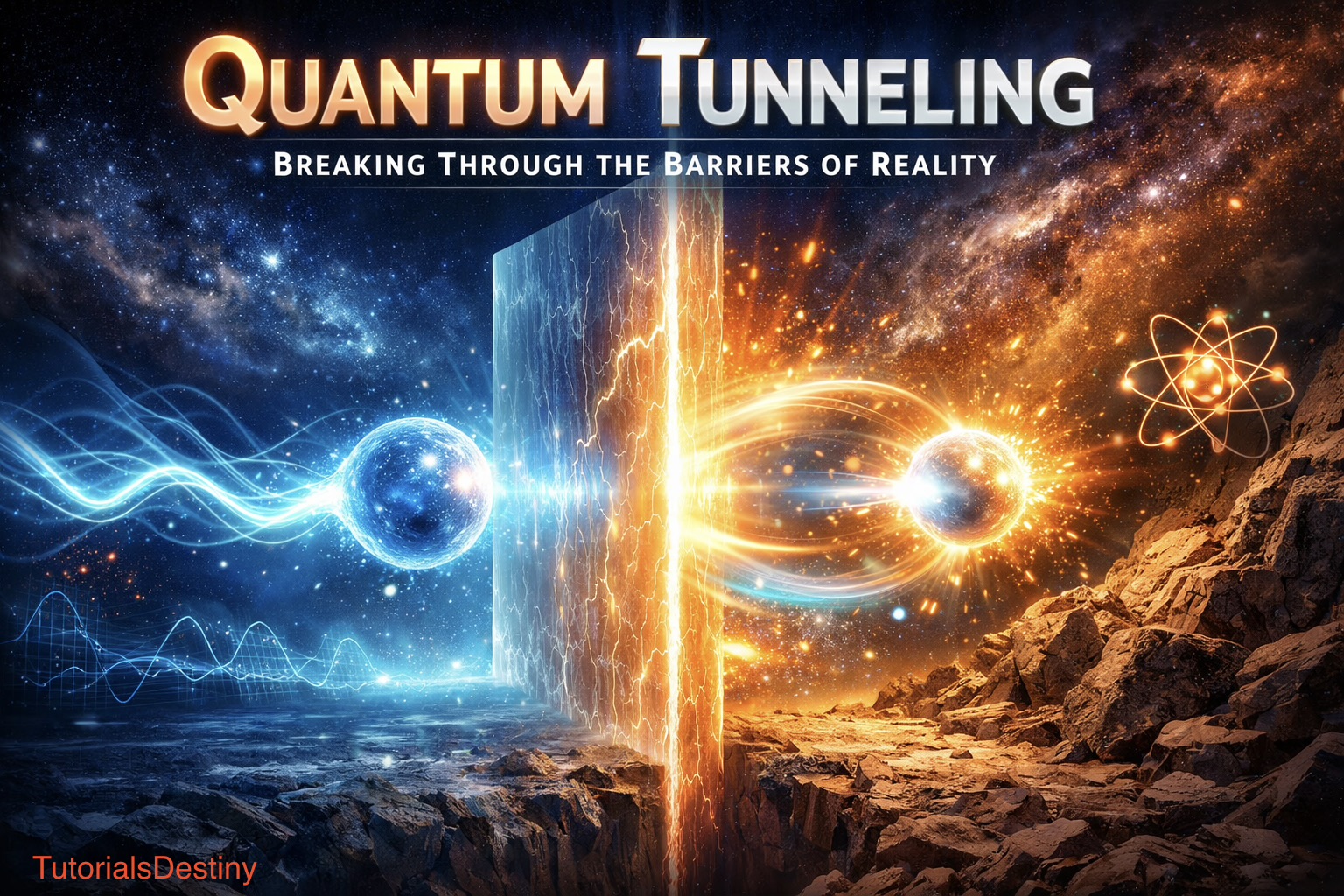
  • Quantum Tunneling: When Particles Break the Rules of Classical Reality

    Quantum Tunneling: When Particles Break the Rules of Classical Reality

    Introduction

    In our everyday experience, physical objects follow strict and predictable rules. A ball thrown at a wall bounces back, and a car cannot cross a barrier without breaking through it. These observations form the foundation of classical physics, which governs the macroscopic world. Classical mechanics assumes that objects have definite positions, energies, and trajectories, and that motion is fully determined by forces and energy conservation.

    However, when we move from the visible world to the microscopic realm of atoms, electrons, and subatomic particles, these familiar rules begin to fail. Nature behaves in ways that are often counter-intuitive and probabilistic rather than deterministic. One of the most fascinating phenomena arising from this quantum domain is quantum tunneling—a process in which particles pass through energy barriers that they seemingly should not be able to cross.

    Quantum tunneling is not merely a theoretical curiosity. It is a fundamental mechanism behind nuclear fusion in stars, radioactive decay, modern electronic devices, and advanced scientific instruments. This phenomenon challenges classical intuition and reveals the true nature of reality at the smallest scales.

    Understanding Quantum Tunneling

    At its core, quantum tunneling refers to the phenomenon where a particle has a non-zero probability of passing through a potential energy barrier, even when its total energy is less than the height of that barrier.

    In classical physics:i

    • A particle approaching a barrier with insufficient energy must be reflected.
    • The probability of crossing the barrier is strictly zero.

    Quantum mechanics, however, introduces probability as a fundamental aspect of nature. According to this framework, particles are described by wavefunctions, mathematical entities that provide information about the likelihood of finding a particle at a particular position.

    When a particle encounters a barrier:

    • Its wavefunction does not abruptly end at the boundary.
    • Instead, it penetrates into the barrier and decays exponentially.
    • If the barrier is thin enough, the wavefunction may extend beyond it, allowing the particle to appear on the other side.

    This process—where a particle effectively “passes through” a barrier without climbing over it—is known as quantum tunneling.

    Wave–Particle Duality: The Foundation of Tunneling

    Quantum tunneling is a direct consequence of wave–particle duality, one of the central principles of quantum mechanics. According to this principle:

    • Every particle exhibits both particle-like and wave-like behavior.
    • Electrons, protons, and even atoms can behave as waves under certain conditions.

    Unlike classical particles, waves do not have sharply defined positions. They spread out over space, allowing parts of the wave to exist in regions that would be forbidden for a classical particle. When a quantum particle approaches a barrier, its wavefunction spreads into the barrier region, making tunneling possible.

    This dual nature challenges our classical intuition but provides a more accurate description of the microscopic universe.

    A Simple Analogy to Visualize Tunneling

    To visualize quantum tunneling, imagine rolling a ball toward a hill.

    • In classical physics, the ball must have enough energy to climb over the hill.
    • If it lacks sufficient energy, it rolls back.

    In quantum physics, the “ball” behaves like a wave:

    • The wave spreads out as it approaches the hill.
    • A portion of the wave may appear on the other side.
    • When measured, the particle may be detected beyond the barrier.

    The particle does not physically climb the hill—it tunnels through it.

    Classical vs Quantum Mechanics

    Classical View

    According to classical mechanics, the kinetic energy of a particle is:

    \[K = \frac{1}{2}mv^2\]

    Since:

    • Mass \(m\) is always positive
    • Velocity squared \(v^2\) is always positive

    Kinetic energy can never be negative. If a particle encounters a potential barrier of height \(V_0\) and its total energy \(E < V_0\), then its kinetic energy inside the barrier would be negative—an impossible situation in classical physics. Hence, total reflection is predicted.

    Quantum Mechanical View

    Quantum mechanics allows total reflection only when the barrier height is infinite. For a finite potential barrier, even if \(E < V_0\), there is a finite probability that the particle will appear on the other side.

    This crucial difference gives rise to quantum tunneling.

    Mathematical Perspective (Conceptual)

    Quantum behavior is governed by the time-independent Schrödinger equation (TISE):

    \[\frac{d^2 \psi}{dx^2} + \frac{2m}{\hbar^2}(E – V)\psi = 0\]

    Here:

    • \(\psi(x)\) is the wavefunction
    • \(|\psi(x)|^2 \)represents probability density
    • \(E\) is total energy
    • \(V(x)\) is potential energy

    The Schrödinger equation predicts that the wavefunction decays exponentially inside a barrier but does not become zero, allowing tunneling to occur.

    Quantum Mechanical Tunneling: Potential Barrier Model

    To understand tunneling rigorously, consider a one-dimensional finite potential barrier divided into three regions.

    Potential Definition

    \[V(x) = \begin{cases} 0, & x < 0 \quad \text{(Region I)} \\ V_0, & 0 \le x \le a \quad \text{(Region II)} \\ 0, & x > a \quad \text{(Region III)} \end{cases}\]

    where:

    • \(V_0\) is the barrier height
    • \(a\) is the barrier width
    • \(E < V_0\)

    Region I: \( x < 0\) (Incident and Reflected Waves)

    The Schrödinger equation becomes:

    \[\frac{d^2 \psi}{dx^2} + k_1^2 \psi = 0\]

    where:

    \[k_1 = \sqrt{\frac{2mE}{\hbar^2}}\]

    The solution is:

    \[\psi_1(x) = A e^{ik_1 x} + B e^{-ik_1 x}\]

    • First term: incident wave
    • Second term: reflected wave

    Region II: \(0 < x < a\) (Inside the Barrier)

    Here, \(E < V_0\), so the equation becomes:

    \[\frac{d^2 \psi}{dx^2} – k_2^2 \psi = 0\]

    with:

    \[k_2 = \sqrt{\frac{2m(V_0 – E)}{\hbar^2}}\]

    The solution is:

    \[\psi_2(x) = C e^{k_2 x} + D e^{-k_2 x}\]

    This region features exponentially decaying wavefunctions, representing barrier penetration.

    Region III: \( x > a\) (Transmitted Wave)

    The equation again becomes:

    \[\frac{d^2 \psi}{dx^2} + k_1^2 \psi = 0\]

    The solution is:

    \[\psi_3(x) = F e^{ik_1 x}\]

    Only a transmitted wave exists here; no wave travels backward.

    Transmission and Reflection Coefficients

    Applying boundary conditions at \(x = 0\) and \(x = a\), the transmission coefficient is obtained as:

    \[T = \frac{1}{1 + \frac{V_0^2}{4E(V_0 – E)} \sinh^2(k_2 a)}\]

    This expression shows that:

    • \(T \neq 0\) even when \(E < V_0\)
    • Tunneling probability decreases with increasing barrier width and height
    • Lighter particles tunnel more easily

    Quantum Tunneling in Nature

    1. Nuclear Fusion in the Sun

    Quantum tunneling is essential for the energy production in stars. Inside the Sun:

    • Protons repel each other due to electrostatic forces.
    • Classically, their thermal energy is insufficient to overcome this repulsion.
    • Quantum tunneling allows protons to approach closely enough for the strong nuclear force to bind them.

    This process enables nuclear fusion, releasing vast amounts of energy that power the Sun and sustain life on Earth. Without quantum tunneling, stars would not shine.

    2. Radioactive Alpha Decay

    In radioactive nuclei:

    • Alpha particles are trapped inside the nucleus by a strong potential barrier.
    • Classical physics predicts they should remain confined indefinitely.
    • Quantum tunneling allows them to escape.

    This escape results in alpha decay, a fundamental form of radioactivity. The rate of decay depends on the tunneling probability, which explains why different radioactive elements have different half-lives.

    Technological Applications of Quantum Tunneling

    1. Scanning Tunneling Microscope (STM)

    The scanning tunneling microscope is one of the most direct technological applications of quantum tunneling. It operates by:

    • Bringing a sharp metallic tip extremely close to a surface.
    • Applying a small voltage between the tip and the surface.
    • Measuring the tunneling current produced by electrons.

    This current is highly sensitive to distance, allowing scientists to image individual atoms. The STM revolutionized surface science and nanotechnology.

    2. Semiconductor Devices

    Quantum tunneling plays a crucial role in modern electronics, especially as devices shrink to nanometer scales.

    Applications include:

    • Tunnel diodes
    • Flash memory
    • Transistors in integrated circuits

    As components become smaller, tunneling effects become unavoidable. Engineers must carefully design devices to either utilize or suppress tunneling, depending on the application.

    3. Quantum Computing

    In quantum computing:

    • Tunneling enables particles to transition between quantum states.
    • It plays a role in quantum annealing and optimization algorithms.

    Quantum tunneling allows quantum computers to explore solution spaces more efficiently than classical computers for certain problems.

    Importance of Quantum Tunneling

    Quantum tunneling is not merely a theoretical concept. Its importance lies in its ability to:

    • Explain phenomena that classical physics cannot
    • Enable advanced experimental techniques
    • Drive technological innovation
    • Deepen our understanding of the quantum nature of reality

    It demonstrates that probability, rather than certainty, governs the microscopic world.

    Limitations and Common Misconceptions

    Despite its extraordinary nature, quantum tunneling has clear limitations:

    • It does not allow macroscopic objects to pass through walls.
    • The tunneling probability for large objects is effectively zero.
    • It does not violate conservation of energy or physical laws.

    Quantum tunneling is significant only at atomic and subatomic scales.

    Philosophical Implications

    Quantum tunneling raises profound philosophical questions about determinism and reality. It suggests that:

    • Nature is fundamentally probabilistic.
    • Events are governed by likelihood rather than certainty.
    • Observation plays a critical role in determining outcomes.

    These ideas challenge classical notions of causality and determinism.

    Conclusion

    Quantum tunneling stands as one of the most striking and beautiful phenomena in physics. It reveals a universe where particles behave as waves, barriers are not absolute, and the impossible becomes possible—at least with some probability. From powering the stars to enabling cutting-edge technology, quantum tunneling silently shapes both the cosmos and our everyday lives.

    By challenging our intuition and expanding our understanding of nature, quantum tunneling reminds us that reality at its deepest level is far richer and stranger than it appears.

    In the quantum world, even the gimpossible has a chance.

  • What Is a CDN (Content Delivery Network)?

    What Is a CDN (Content Delivery Network)?

    Introduction

    CDN (Content Delivery Network) is a network of geographically distributed servers that work together to deliver digital content—such as images, videos, stylesheets, scripts, and entire web pages—efficiently, reliably, and quickly to users. These servers cache content closer to end-users to minimize delays and reduce server load, significantly improving website performance and user experience.


    What Does a CDN Do?

    When a user visits your website:

    • Without a CDN: The user’s request travels to your origin server (which could be far away), increasing latency and server load.
    • With a CDN: The request is routed to the nearest CDN edge server, which serves the cached content, drastically improving speed and user experience.

    A CDN also:

    • Balances traffic across multiple servers
    • Detects the optimal server for each request
    • Acts as a shield for your origin server against spikes and attacks

    Key Features of a CDN

    • Edge servers distributed globally
    • Static and dynamic content caching
    • Load balancing and failover mechanisms
    • Real-time DDoS mitigation and Web Application Firewall (WAF)
    • TLS/SSL encryption support for secure delivery
    • Real-time analytics and usage metrics

    Why You Need a CDN

    Implementing a CDN provides multiple performance and business advantages:

    BenefitDescription
    🌐 Faster Load TimesReduced distance between users and content servers
    📈 Better PerformanceOffloads traffic from your main server
    🔒 Improved SecurityBuilt-in DDoS protection and encrypted data transfer
    📉 Reduced Bandwidth CostsEfficient caching minimizes requests to origin server
    📊 Higher SEO & EngagementFaster sites rank better and retain users longer
    🌍 Global ScalabilityEnsures consistent performance for users worldwide

    Real-World Use Cases

    • E-commerce sites: Fast page loads increase conversion rates and reduce cart abandonment.
    • Streaming services: CDNs enable smooth video delivery and adaptive streaming.
    • Media and news outlets: Handle sudden traffic surges during major events.
    • Mobile apps and gaming platforms: Accelerate content delivery and updates.
    • Enterprise websites: Maintain reliable and secure global access to resources.

    Popular CDN Providers

    • Cloudflare – Known for performance, security, and free tiers.
    • Akamai – One of the oldest and largest CDN providers with enterprise features.
    • Amazon CloudFront – Deeply integrated with AWS services.
    • Google Cloud CDN – Seamless integration with Google Cloud infrastructure.
    • Fastly – Popular for real-time content delivery and edge computing.

  • How to Use Python Documentation Effectively

    How to Use Python Documentation Effectively

    Introduction

    Understanding and navigating Python documentation is a vital skill for every developer. Whether you’re debugging code, exploring new modules, or learning how a specific function works—knowing how to use the official Python documentation will save you time and elevate your coding.


    What is Python Documentation?

    Python documentation is the official reference published by the Python Software Foundation. It contains detailed information about:

    • Syntax rules and data types
    • Built-in functions and exceptions
    • Standard library modules
    • Best practices and tutorials

    Official documentation site: https://docs.python.org/3/


    How to Navigate the Python Docs

    Mastering how to explore the documentation can dramatically improve your self-sufficiency.

    1. Start With the Search Bar
      Type keywords like list, for loop, or zip() to jump to relevant topics quickly.
    2. Understand the Structure
      • Tutorial: Beginner-friendly introduction to Python
      • Library Reference: Complete details on standard modules and functions
      • Language Reference: Covers core syntax and semantics
      • FAQs and Glossary: Quick clarifications and key terms
    3. Use the Sidebar or Module Index
      Find topics alphabetically or browse by category (e.g., File I/O, Networking, Math).
    4. Follow Cross-References
      Many pages link to related modules or advanced usage examples.

    Key Elements to Pay Attention To

    When reading documentation, focus on the following:

    Function Signatures

    Shows the required arguments, optional parameters (with default values), and return types.
    📌 Example: random.randint(a, b) → int

    Parameters and Return Values

    Every function includes a detailed breakdown of what inputs it accepts and what it returns.

    ⚠️ Notes and Warnings

    These provide cautionary information, edge cases, or behavior that differs between versions.

    Version Compatibility

    Not all functions are available in every version of Python. Watch for “New in version…” notes.

    Code Examples

    Most entries include real examples that show how to use the function—perfect for quick testing.


    Tips for Using Python Docs Effectively

    • Start with the Tutorial if you’re new.
    • Bookmark useful pages like:
    • Test what you read immediately in your IDE or REPL (e.g., Python shell, Jupyter).
    • If you don’t understand a parameter, check its data type and see how it behaves in practice.
    • Use examples as templates. Modify and run them to understand how they work.
    • Combine docs with hands-on experimentation for deep learning.
    • Still confused? Look for the same topic on Real Python, Stack Overflow, or YouTube—but always start with the docs!

    Practice Activity

    Try this hands-on challenge to get comfortable with the documentation:

    1. Go to the documentation for the random module.
    2. Explore functions like random.choice(), random.randint(), and random.shuffle().
    3. In your IDE, test each function with different arguments.
    4. Reflect on:
      • What inputs did it accept?
      • What output did it return?
      • Was there anything unexpected or new?

    Essential Documentation Links

    CategoryLink
    Python 3 Main Docsdocs.python.org/3
    Built-in Functionsfunctions.html
    Python Tutorialtutorial/index.html
    Standard Library (Modules)py-modindex.html

    Final Thoughts

    Reading documentation may feel overwhelming at first, but it becomes easier and incredibly rewarding with practice. Start with modules you frequently use, and make it a habit to read about unfamiliar functions before searching elsewhere.

    The better you get at reading docs, the faster and more independently you’ll be able to code.


  • Writing Clean and Readable Code (PEP8 Guidelines)

    Writing Clean and Readable Code (PEP8 Guidelines)

    Introduction

    A guide to writing beautiful, readable, and professional Python code

    Writing clean and readable code is essential for collaboration, maintenance, and debugging. Python promotes readability through its official style guide, PEP8 (Python Enhancement Proposal 8). This module will walk you through the core PEP8 guidelines and best practices to help you write code that looks good and makes sense to others (and your future self).


    Why Code Style Matters

    • Readability: Clear formatting and naming make code easier to understand.
    • Consistency: Consistent style reduces cognitive load when switching between projects.
    • Collaboration: Well-formatted code is easier to review, debug, and maintain in teams.
    • Professionalism: Clean code reflects good discipline and professionalism.

    Formatting and Layout Rules

    Indentation

    Use 4 spaces per indentation level. Avoid using tabs.

    def greet(name):
        print("Hello,", name)

    Maximum Line Length

    Keep lines under 79 characters. For docstrings or comments, aim for 72 characters.

    # This is a comment that follows the recommended line length guidelines.

    Line Breaks

    Use blank lines to separate:

    • Functions and class definitions
    • Logical sections of code inside a function

    Naming Conventions

    ElementConventionExample
    Variablelower_case_with_underscoresuser_name
    Functionlower_case_with_underscorescalculate_total()
    ClassCapitalizedWordsUserProfile
    ConstantALL_CAPS_WITH_UNDERSCORESMAX_RETRIES

    🚫 Avoid single-letter variable names unless used in short loops.


    Writing Comments and Docstrings

    Inline Comments

    Should be brief and start with a #, with one space after it.

    x = x + 1  # Increment x by 1

    Block Comments

    Use for longer explanations before code blocks. They should be indented at the same level as the code.

    Docstrings

    Use triple quotes to describe functions, classes, or modules.

    def multiply(a, b):
        """Returns the product of two numbers."""
        return a * b

    Spacing Rules

    • No extra spaces around = when used for keyword arguments or default values.
    • One space around binary operators (+, -, =, etc.)
    • No space between a function name and its opening parenthesis.
    # Correct:
    total = a + b
    def greet(name):
    
    # Incorrect:
    total=a+b
    def greet (name):

    Tools for Code Style and Formatting

    1. Black – The uncompromising code formatter.
    2. flake8 – Checks your code against PEP8 and detects style violations.
    3. pylint – Linter that also checks for code smells and possible bugs.
    4. isort – Automatically sorts your Python imports.

    💡 Most IDEs like VS Code and PyCharm support these tools with extensions or built-in integrations.


    💡 Pro Tips

    • Use consistent indentation throughout the project.
    • Use descriptive names instead of short unclear ones.
    • Keep functions small and focused on a single task.
    • Don’t over-comment obvious code; comment why, not what, when possible.
    • Break long logic into smaller helper functions.
    • Run your code through a formatter like black before finalizing.

    📌 Challenge Exercise:
    Take one of your older Python scripts and refactor it using PEP8 guidelines. Use flake8 or black to identify and fix violations.