Introduction to Machine Learning
Artificial Intelligence has transformed the way computers solve problems, analyze data, and assist humans in decision-making. At the heart of modern AI systems lies Machine Learning (ML) — a branch of AI that enables computers to learn patterns from data instead of being explicitly programmed for every task.
Machine learning powers recommendation systems, voice assistants, fraud detection tools, autonomous vehicles, medical diagnosis systems, and countless other technologies that are now deeply integrated into daily life. However, machine learning is not a single technique. It is a broad field that includes different learning approaches designed for different types of problems.
The three major categories of machine learning are:
- Supervised Learning
- Unsupervised Learning
- Reinforcement Learning
Each approach has unique goals, learning methods, strengths, and applications. Understanding these categories is essential for anyone beginning a journey into AI and data science because they form the foundation for more advanced topics such as deep learning, natural language processing, robotics, and generative AI.
This lesson explores these three machine learning paradigms in detail, explaining how they work, where they are used, and why they matter in modern AI systems.
What Is Machine Learning?
Machine learning is a field of computer science that focuses on building systems capable of learning from data. Instead of relying only on fixed rules written by programmers, machine learning models improve their performance by analyzing examples and discovering patterns.
Traditional programming works like this:
- Input + Rules → Output
Machine learning changes the approach:
- Input + Output Examples → Learned Rules
This ability to learn from experience allows machines to handle complex tasks that are difficult to solve using manually written rules.
Examples include:
- Recognizing faces in photographs
- Predicting weather conditions
- Detecting spam emails
- Translating languages
- Recommending movies or products
- Driving autonomous vehicles
Machine learning systems rely heavily on data. The type of data available and the learning objective determine which learning approach should be used.
The Three Main Types of Machine Learning
Machine learning methods are generally grouped into three categories:
| Learning Type | Main Idea |
| Supervised Learning | Learn from labeled data |
| Unsupervised Learning | Discover hidden patterns in unlabeled data |
| Reinforcement Learning | Learn through rewards and penalties |
These approaches differ in how the model receives information and how learning occurs.
Supervised Learning
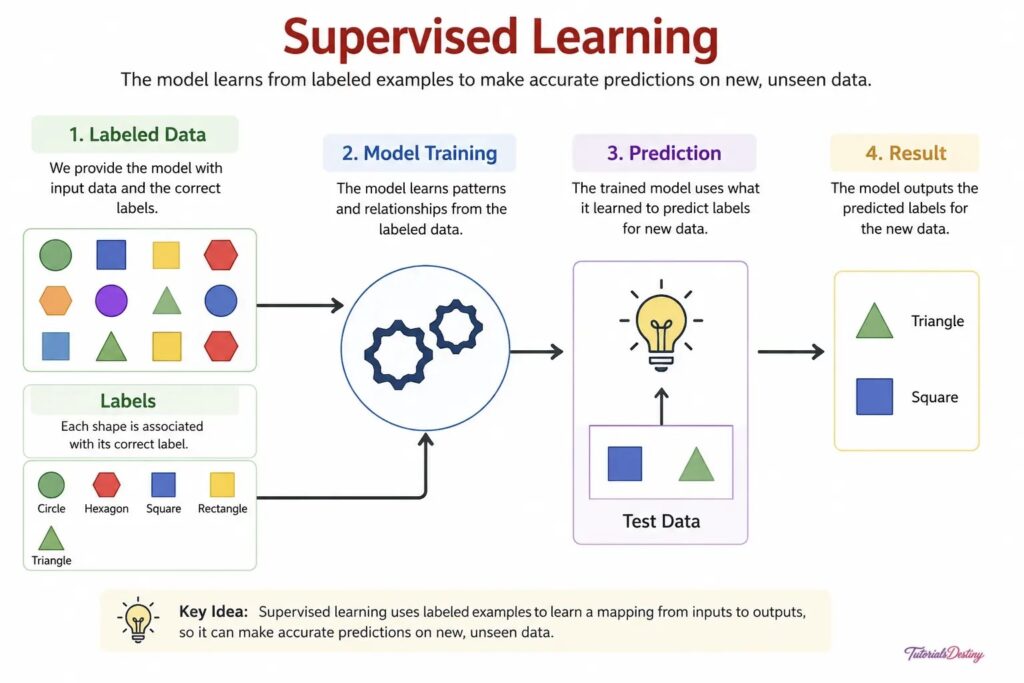
Supervised learning is the most widely used type of machine learning. In this approach, the algorithm learns using labeled data.
A labeled dataset contains:
- Input data
- Correct output labels
The model studies examples and learns the relationship between inputs and outputs so it can make predictions on new unseen data.
Understanding Supervised Learning with an Example
Imagine teaching a child to recognize fruits.
You show:
- An image of an apple labeled “Apple”
- An image of a banana labeled “Banana”
- An image of an orange labeled “Orange”
Over time, the child learns the patterns associated with each fruit.
Supervised learning works similarly. The algorithm learns from examples that already contain correct answers.
Components of Supervised Learning
Supervised learning systems generally include:
Input Features
These are the attributes or characteristics used for learning.
Examples:
- House size
- Number of bedrooms
- Age of a customer
- Email text
Labels or Targets
These are the correct outputs.
Examples:
- House price
- Spam or not spam
- Disease present or absent
Model
The mathematical system that learns patterns from data.
Training Process
The model compares predictions with actual answers and adjusts itself to improve accuracy.
Types of Supervised Learning
Supervised learning is mainly divided into two categories:
Classification
Classification predicts categories or classes.
Examples:
- Spam vs non-spam email
- Fraudulent vs legitimate transaction
- Cat vs dog image recognition
The output is discrete.
Common Classification Algorithms
- Logistic Regression
- Decision Trees
- Random Forest
- Support Vector Machines
- Neural Networks
Regression
Regression predicts continuous numerical values.
Examples:
- Predicting stock prices
- Estimating house prices
- Forecasting temperature
The output is numerical rather than categorical.
Common Regression Algorithms
- Linear Regression
- Polynomial Regression
- Decision Tree Regression
- Neural Network Regression
How Supervised Learning Works
The supervised learning workflow usually follows these steps:
Step 1: Collect Data
A dataset with labeled examples is gathered.
Step 2: Prepare the Data
The data is cleaned and formatted.
This may include:
- Removing duplicates
- Handling missing values
- Scaling features
Step 3: Train the Model
The model studies patterns in the training data.
Step 4: Evaluate Performance
The model is tested using unseen data.
Step 5: Make Predictions
The trained model predicts outputs for new data.
Advantages of Supervised Learning
Supervised learning offers several important benefits.
- High Accuracy: When quality labeled data is available, supervised models can achieve excellent performance.
- Clear Objective:The learning goal is well-defined because correct outputs are known.
- Easy Evaluation: Performance metrics such as accuracy and precision help measure effectiveness.
- Widely Applicable:Supervised learning is useful in many industries.
Limitations of Supervised Learning
Despite its strengths, supervised learning also has challenges.
- Requires Labeled Data: Labeling large datasets can be expensive and time-consuming.
- Risk of Overfitting: Models may memorize training data instead of learning general patterns.
- Data Dependency: Poor-quality data leads to poor predictions.
- Limited Adaptability: Models only learn patterns represented in the training data.
Real-World Applications of Supervised Learning
Supervised learning powers many modern technologies.
Healthcare
- Disease diagnosis
- Medical image analysis
- Patient risk prediction
Finance
- Fraud detection
- Credit scoring
- Market forecasting
E-commerce
- Product recommendations
- Customer behavior prediction
Natural Language Processing
- Spam filtering
- Sentiment analysis
- Language translation
Computer Vision
- Face recognition
- Object detection
- Image classification
Unsupervised Learning
Unsupervised learning works with unlabeled data. Unlike supervised learning, the algorithm is not given correct answers. Instead, it explores the data and identifies hidden structures, relationships, and patterns on its own.
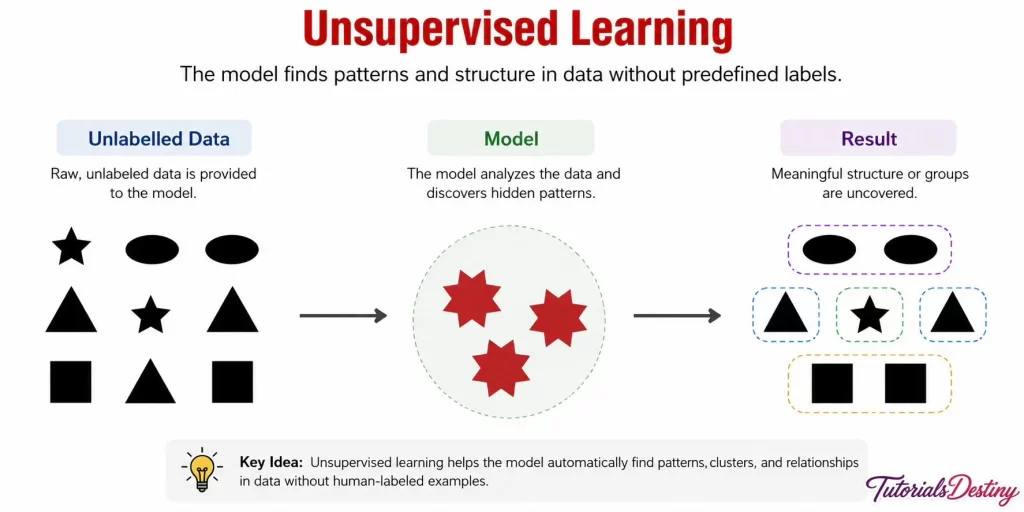
This type of learning is useful when labeled data is unavailable or when researchers want to discover unknown insights.
Understanding Unsupervised Learning with an Example
Imagine giving a child a box of mixed toys without labels.
The child may naturally group:
- Cars together
- Dolls together
- Blocks together
No one explicitly teaches the categories.
Similarly, unsupervised learning algorithms organize data by identifying similarities and differences.
Goals of Unsupervised Learning
Unsupervised learning aims to:
- Find hidden patterns
- Group similar data points
- Detect anomalies
- Reduce data complexity
Types of Unsupervised Learning
Clustering
Clustering groups similar data points together.
Examples:
- Customer segmentation
- Social network analysis
- Market research
Popular Clustering Algorithms
- K-Means
- DBSCAN
- Hierarchical Clustering
Dimensionality Reduction
Large datasets often contain many features.
Dimensionality reduction simplifies data while preserving important information.
Examples:
- Data compression
- Visualization of high-dimensional data
Popular Techniques
- Principal Component Analysis (PCA)
- t-SNE
- Autoencoders
Association Rule Learning
This technique identifies relationships between variables.
Example:
Customers who buy bread often buy butter.
Used heavily in recommendation systems and retail analytics.
Popular Algorithms
- Apriori Algorithm
- FP-Growth
How Unsupervised Learning Works
The workflow generally includes:
Step 1: Input Unlabeled Data
No correct answers are provided.
Step 2: Analyze Patterns
The algorithm searches for similarities or structures.
Step 3: Organize Data
Data points are grouped or transformed.
Step 4: Extract Insights
Useful information is identified.
Advantages of Unsupervised Learning
- No Labeling Required: Large unlabeled datasets can be used directly.
- Discover Hidden Insights: Useful for finding unknown patterns.
- Data Exploration: Helps understand complex datasets.
- Useful for Preprocessing: Often used before supervised learning.
Limitations of Unsupervised Learning
- Difficult Evaluation: No correct answers exist for direct comparison.
- Results May Be Ambiguous: Patterns discovered may not always be meaningful.
- Sensitive to Data Quality: Noise and irrelevant features can affect performance.
- Computational Complexity:Some algorithms require high processing power.
Real-World Applications of Unsupervised Learning
- Customer Segmentation: Businesses group customers based on behavior.
- Recommendation Systems: Streaming and shopping platforms identify similar user preferences.
- Fraud Detection: Anomalies may indicate suspicious activities.
- Social Network Analysis: Communities and relationships are identified automatically.
- Biological Research: Gene patterns and disease clusters are analyzed.
Reinforcement Learning
Reinforcement learning is inspired by behavioral psychology.
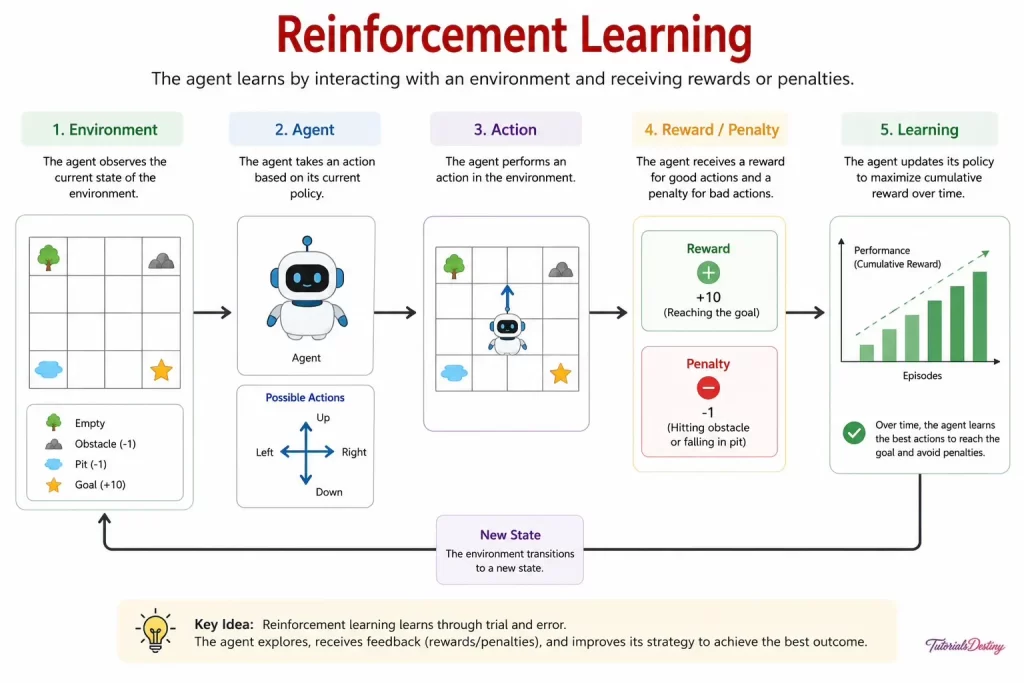
In this approach, an agent learns by interacting with an environment and receiving rewards or penalties based on actions.
The goal is to maximize long-term rewards.
Understanding Reinforcement Learning with an Example
Imagine training a robot.
- Correct behavior → reward
- Incorrect behavior → no reward or penalty
Over time, the robot learns which actions produce better outcomes.
Reinforcement learning operates similarly.
Key Components of Reinforcement Learning
Agent
The learner or decision-maker.
Example:
- Robot
- Game-playing AI
- Self-driving car
Environment
The world in which the agent operates.
State
The current situation of the environment.
Action
A decision made by the agent.
Reward
Feedback received after an action.
How Reinforcement Learning Works
The learning cycle includes:
- Agent observes environment
- Agent takes action
- Environment changes
- Reward is received
- Agent updates strategy
This cycle repeats continuously.
Important Reinforcement Learning Concepts
Policy
A strategy that determines actions.
Reward Function
Defines how success is measured.
Exploration vs Exploitation
The agent balances:
- Trying new actions
- Using known successful actions
Q-Value
Measures expected future rewards.
Types of Reinforcement Learning
Model-Free Reinforcement Learning
The agent learns directly from experience.
Examples:
- Q-Learning
- Deep Q Networks (DQN)
Model-Based Reinforcement Learning
The agent builds a model of the environment.
This can improve planning and efficiency.
Advantages of Reinforcement Learning
- Learns Through Interaction: No labeled data is required.
- Handles Complex Decision-Making: Useful in dynamic environments.
- Continuous Improvement: Performance improves over time.
- Suitable for Sequential Problems:Excellent for long-term strategy tasks.
Limitations of Reinforcement Learning
- Requires Large Training Time: Learning can be slow.
- Computationally ExpensiveComplex environments need high computing power.
- Difficult Reward Design: Poor reward systems can produce unwanted behavior.
- Stability Challenges: Training may become unstable.
Real-World Applications of Reinforcement Learning
- Robotics: Robots learn movement and navigation.
- Gaming: AI systems master games like chess and Go.
- Autonomous Vehicles: Cars learn driving strategies.
- Finance: Trading systems optimize investment strategies.
- Resource Management:Data centers optimize energy usage.
Comparing the Three Learning Approaches
| Feature | Supervised Learning | Unsupervised Learning | Reinforcement Learning |
| Data Type | Labeled | Unlabeled | Interaction-based |
| Goal | Predict outputs | Find patterns | Maximize rewards |
| Feedback | Direct | None | Reward signals |
| Common Tasks | Classification, regression | Clustering, dimensionality reduction | Decision-making |
| Example | Spam detection | Customer segmentation | Self-driving cars |
Choosing the Right Learning Approach
The choice depends on:
- Data availability
- Problem type
- Desired outcome
Use supervised learning when labeled data exists.
Use unsupervised learning when exploring hidden structures.
Use reinforcement learning when decisions and rewards are involved.
Relationship Between the Three Approaches
These learning methods are not isolated.
Modern AI systems often combine them.
Examples:
- Reinforcement learning may use deep neural networks.
- Supervised learning may preprocess data using unsupervised techniques.
- Generative AI systems combine multiple learning paradigms.
Hybrid approaches are becoming increasingly common in advanced AI applications.
Deep Learning and the Three Learning Types
Deep learning can be applied to:
- Supervised learning
- Unsupervised learning
- Reinforcement learning
Examples include:
- CNNs for image classification
- Autoencoders for unsupervised learning
- Deep Q Networks for reinforcement learning
This combination has enabled breakthroughs in:
- Speech recognition
- Autonomous driving
- Large language models
- Medical imaging
Future of Machine Learning
Machine learning continues to evolve rapidly.
Emerging areas include:
- Self-supervised learning
- Federated learning
- Explainable AI
- Generative AI
- Multimodal learning
As data availability and computing power grow, machine learning systems are becoming more powerful, adaptive, and capable of solving increasingly complex problems.
Conclusion
Supervised, unsupervised, and reinforcement learning form the core foundations of modern machine learning.
Each approach solves different types of problems:
- Supervised learning predicts outcomes using labeled data.
- Unsupervised learning discovers hidden patterns in unlabeled data.
- Reinforcement learning learns optimal behavior through rewards and interactions.
Together, these learning paradigms power many of the intelligent systems used across healthcare, finance, transportation, robotics, education, cybersecurity, entertainment, and countless other industries.
Understanding these concepts provides the foundation for studying advanced AI topics such as deep learning, natural language processing, computer vision, robotics, and generative AI systems.
As artificial intelligence continues to transform society, knowledge of these machine learning approaches will remain essential for researchers, developers, businesses, and future AI professionals.