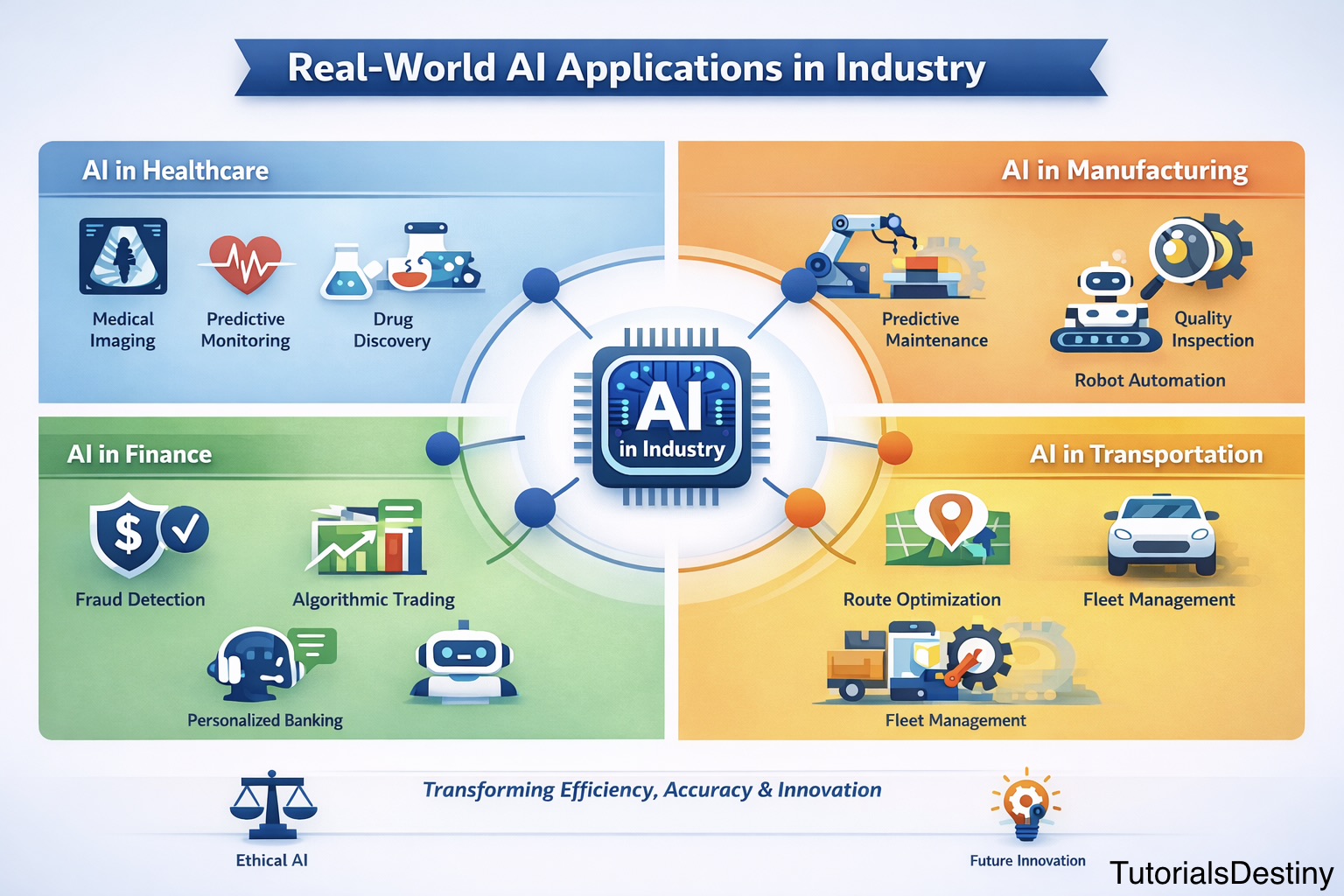
Real-World AI Applications in Industry
Artificial Intelligence (AI) has shifted from academic research to real-world transformation. Across industries—from healthcare and manufacturing to finance and logistics—AI systems are driving efficiency, improving accuracy, reducing costs, forecasting trends, and enabling entirely new business models. This 1800+-word article explores major AI applications, real use cases, core technologies powering them, and the broader impact on society and industry.
What is AI and Why It Matters in Industry
Artificial Intelligence refers to computational systems capable of performing tasks that normally require human intelligence—such as visual perception, language understanding, decision-making, and learning. Modern AI includes:
- Machine Learning (ML) — Algorithms that learn patterns from data.
- Deep Learning (DL) — Neural networks with many layers for complex tasks like image and speech recognition.
- Natural Language Processing (NLP) — Understanding and generating human language.
- Computer Vision (CV) — Understanding visual data from images and video.
- Robotics & Automation — Intelligent machines performing physical tasks.
AI matters because:
- It automates repetitive and complex tasks.
- It augments human decision-making with data insights.
- It enables real-time operations at scale.
- It unlocks innovation and new revenue streams.
AI in Healthcare
The healthcare industry is among the fastest to adopt AI, with applications that touch clinical care, diagnostics, drug discovery, and patient monitoring.
1. Medical Image Analysis
AI models, especially deep learning, analyze medical images (X-rays, MRIs, CT scans) with high accuracy. These systems can:
- Detect tumors and fractures
- Identify early signs of diseases such as cancer
- Reduce diagnostic time for radiologists
Real use case: AI-powered cancer screening tools can detect malignancies earlier than traditional methods, helping clinicians make faster decisions and improving patient outcomes.
2. Predictive Healthcare & Patient Monitoring:
AI analyzes patient data from wearable devices and EHRs to:
- Predict health events (e.g., heart attacks)
- Monitor vitals and alert clinicians in real time
- Personalize treatment plans based on patient history
Example: Smart wearables detect irregular heart rhythms and send alerts to doctors before symptoms worsen.
3. Drug Discovery:
AI accelerates drug discovery by:
- Predicting molecular interactions
- Designing new compounds
- Simulating clinical outcomes
This drastically reduces time and cost compared to traditional researchers.
AI in Manufacturing and Industry 4.0
Manufacturing industries are undergoing a transformation known as Industry 4.0, where smart factories leverage AI, IoT (Internet of Things), robotics, and digital systems.
1. Predictive Maintenance
AI predicts machine failures before they occur by analyzing sensor data and historical patterns. Benefits include:
- Minimizing downtime
- Reducing repair costs
- Extending machinery lifespan
Real use case: AI systems monitor vibration, temperature, and pressure to schedule maintenance only when needed, rather than on fixed intervals.
2. Quality Inspection
Traditionally manual and error-prone, visual quality inspection is now automated through AI:
- Computer vision systems detect defects on production lines
- Models learn to identify subtle deviations faster and more accurately than the human eye
This ensures uniform product quality and reduces waste.
3. Autonomous Robotics
Manufacturing robots with AI can:
- Collaborate with humans on complex tasks
- Adapt in real time to changing workflows
- Sort and move materials independently
These systems increase scalability and operational flexibility.
AI in Finance and Banking
AI is reshaping financial services, improving customer experience and security while optimizing decision-making.
1. Fraud Detection and Risk Management
Machine learning models detect unusual patterns in transaction data that signify fraud. AI helps:
- Identify anomalies in real time
- Reduce false positives
- Strengthen cybersecurity defenses
Banks deploy AI systems to flag suspicious behavior and protect customers.
2. Algorithmic Trading
AI systems analyze market data at scale and execute trades with speed beyond human capability. They:
- Predict market trends
- Optimize portfolio performance
- React to events milliseconds after they occur
This has transformed investment banking and hedge funds.
3. Personalized Financial Services
AI chatbots and virtual assistants help customers:
- Query account information
- Receive personalized advice
- Manage loans and investments
Conversational AI reduces call-center burden and improves customer satisfaction.
4. AI in Stock Trend Prediction
AI-based stock prediction systems rely on multiple techniques:
- Machine Learning Models
- Deep Learning and Time-Series Models
- Sentiment Analysis.
However, it is important to note that AI does not guarantee profits. Financial markets remain unpredictable due to sudden global events, policy changes, or economic shocks. AI improves probability-based forecasting but cannot eliminate uncertainty
AI in Retail and E-Commerce
From personalized recommendations to inventory optimization, AI enhances every aspect of the retail experience.
1. Recommendation Engines
Retailers use AI to analyze customer behavior and preferences to:
- Recommend products
- Increase cross-selling and upselling
- Improve purchase conversion rates
Systems like collaborative filtering and deep learning provide personalized shopping experiences.
2. Inventory Management
AI improves demand forecasting and supply planning:
- Reduces overstocking or stockouts
- Optimizes pricing in real time
- Predicts seasonal demand
This results in cost savings and increased revenue.
3. Customer Service Automation
Chatbots and AI support systems handle:
- Customer inquiries
- Returns and refunds
- Order tracking
This reduces staff workload and provides instant help to customers worldwide.
AI in Transportation & Autonomous Systems
AI is essential in reshaping how transportation and logistics operate.
1. Autonomous Vehicles
Self-driving cars and trucks rely on AI to:
- Perceive surroundings via sensors and cameras
- Navigate and make driving decisions
- Communicate with traffic systems
Companies like Tesla, Waymo, and Uber are leaders in this space.
2. Route Optimization
AI systems calculate optimal delivery routes based on:
- Traffic patterns
- Weather conditions
- Delivery windows
This reduces fuel costs, delivery time, and emissions.
3. Predictive Fleet Management
By using AI, logistics firms monitor vehicle health, driver behavior, and delivery patterns to:
- Reduce breakdowns
- Improve safety
- Increase fleet utilization
AI in Agriculture (AgriTech)
AI helps farmers produce more with less by combining data from sensors, drones, and satellite imaging.
1. Precision Farming
AI systems:
- Analyze soil data to recommend fertilization
- Monitor crop health via drones
- Predict water requirements
This increases yields and reduces environmental impact.
2. Livestock Monitoring
Sensors and AI track:
- Animal health indicators
- Feeding patterns
- Location and activity levels
This improves productivity and animal welfare.
3. Supply Chain Optimization
AI forecasts demand and manages harvest timing, reducing food waste and improving distribution efficiency.
AI in Energy and Utilities
AI is transforming how energy is produced, distributed, and consumed.
1. Smart Grid Management
AI enhances power distribution by:
- Matching supply with real-time demand
- Preventing outages
- Integrating renewable energy efficiently
This results in more resilient and cost-effective grids.
2. Energy Consumption Forecasting
AI systems analyze:
- Weather and usage patterns
- Industrial demand
- Market conditions
This helps utilities optimize generation and reduce waste.
3. Renewable Energy Optimization
AI controls solar and wind systems, predicting energy output and maximizing yield.
AI in Education
Education is becoming more adaptive and accessible through AI.
1. Intelligent Tutoring Systems
AI systems provide:
- Personalized learning paths
- Adaptive quizzes
- Real-time feedback
Students learn at their pace with tailored guidance.
2. Automated Grading
AI models handle:
- Multiple-choice evaluations
- Essay scoring
- Plagiarism detection
This reduces teacher workload and provides timely feedback.
3. Skill Gap Analysis
AI identifies learning gaps and suggests:
- Remedial content
- Skill strengthening modules
- Career-relevant courses
This supports lifelong learning and employability.
AI in Customer Experience
Across industries, customer experience is a core differentiator—and AI plays a major role.
1. Chatbots & Virtual Assistants
AI conversational systems handle:
- Basic support questions
- Appointment scheduling
- Product queries
This ensures 24/7 availability without human staffing costs.
2. Sentiment Analysis
AI analyzes customer feedback from:
- Reviews
- Social media
- Call centers
It helps businesses understand sentiment and refine product offerings.
3. Personalized Marketing
AI systems segment customers and:
- Tailor promotions
- Suggest relevant products
- Email campaigns based on preferences
This improves engagement and increases revenue.
Ethical, Regulatory, and Workforce Impacts of AI
While AI adds value, it raises challenges too.
1. Bias and Fairness
AI systems trained on biased data can produce discriminatory outputs. Responsible AI calls for:
- Diverse data
- Transparent algorithms
- Ethical audits
2. Privacy and Security
AI platforms use massive personal data, raising concerns about:
- Data protection
- Consent
- Surveillance misuse
Regulatory frameworks like GDPR and AI policies aim to govern responsible use.
3. Job Transformation
AI automates tasks, but also creates new roles in:
- AI design and deployment
- Data science
- Human-AI collaboration
Education and retraining become essential workforce strategies.
AI Technology Stack in Industry
Understanding AI’s components helps grasp how solutions are created.
1. Data Infrastructure
Core foundation for AI which includes:
- Data lakes and warehouses
- Real-time streaming
- Data cleaning tools
2. ML and DL Platforms
Algorithms and models are built using:
- TensorFlow, PyTorch (deep learning)
- Scikit-learn (traditional machine learning)
- AutoML (automated model creation)
3. AI Deployment
Models are deployed using:
- Cloud infrastructure (AWS, Azure, Google Cloud)
- Edge computing for real-time on-device processing
- APIs connecting AI with business systems
Examples of AI Transformations in Industry
Below are representative real applications (with industry and purpose):
| Industry | AI Use Case | Outcome |
| Healthcare | AI imaging diagnostics | Faster, more accurate disease detection |
| Manufacturing | Predictive maintenance | Lower downtime & maintenance savings |
| Finance | Fraud detection | Reduced financial loss & better compliance |
| Retail | Recommendation engines | Higher conversion & personalized shopping |
| Agriculture | Precision farming | Increased yields & sustainable practices |
| Energy | Smart grid load balancing | Efficient energy distribution |
| Education | Adaptive learning platforms | Personalized student learning |
| Transportation | Autonomous navigation systems | Safer and optimized mobility |
Future of AI in Industry
The future trajectory of AI includes:
- Explainable AI (XAI): AI systems that explain their decisions so humans can trust and verify them.
- AI + IoT Integration: Smarter ecosystems where sensors and AI make real-time decisions—such as self-optimizing factories.
- Federated Learning: AI learns from decentralized data sources without compromising privacy.
- AI for Sustainability: AI optimizing carbon emissions, energy consumption, recycling processes, and resource allocation.
Conclusion: The Business Value of AI
AI has moved from theoretical to operational—it is no longer optional for competitive industries. Organizations that successfully integrate AI into operations can expect:
- Increased efficiency and lower costs
- Better customer experiences and personalized services
- Insight-driven decisions and predictive capabilities
- Faster innovation cycles
Moreover, responsible and ethical AI—with fair data practices and transparent systems—will be critical as industries deepen their reliance on intelligent systems.
The evolution of AI in industry is not just a technological shift, but a strategic imperative. From automating mundane tasks to unlocking new business frontiers, AI’s impact will continue to expand and redefine how industries function in the 21st century.