Writing Analytical Code That Scales
As datasets grow larger and models become more complex, writing correct code is no longer sufficient. Efficiency becomes critical. An algorithm that runs in one second on a thousand rows may take hours on ten million. Understanding computational efficiency allows you to design analytical systems that scale.
This page introduces the foundational ideas behind computational efficiency—time complexity, memory usage, algorithmic growth, and practical performance strategies in Python.
The goal is not to turn you into a computer scientist, but to ensure you understand how computation behaves as data grows.
Why Efficiency Matters in Analytics
In small classroom examples, inefficiencies are invisible. But in production systems:
- Data may contain millions of records.
- Models may require repeated iterations.
- Pipelines may execute daily or in real time.
Inefficient computation leads to:
- Slow dashboards
- Delayed reports
- Increased cloud costs
- Model retraining bottlenecks
Efficiency is not about optimization for its own sake—it is about scalability and reliability.
Understanding Algorithmic Growth
The central idea in computational efficiency is how runtime grows as input size increases.
If we denote input size as
A simple linear function illustrates proportional growth:
y = mx
Slope (m)
m = 1
The slope controls how steep the line is.
In linear time complexity (often written as \(O(n)\)), runtime increases proportionally with input size.
If you double the dataset size, runtime roughly doubles.
This is generally acceptable for analytics tasks.
Constant, Linear, and Quadratic Time
There are common categories of time complexity:
Constant time (O(1))
Runtime does not depend on input size. Accessing an array element by index is constant time.
Linear time (O(n))
Runtime grows proportionally with data size. Iterating once over a dataset is linear.
Quadratic time (O(n²))
Runtime grows with the square of input size. Nested loops over the same dataset often produce quadratic complexity.
Quadratic growth behaves like:
Quadratic Growth
y = x²
Scale Factor
Scale: 1
If input size doubles, runtime increases fourfold. This becomes catastrophic at scale.
For example, a nested loop over 10,000 elements requires 100 million operations.
Understanding this growth pattern helps you avoid performance pitfalls.
Big-O Notation
Big-O notation describes the upper bound of algorithmic growth as input size approaches infinity.
It focuses on dominant growth terms, ignoring constants.
For example:
- \(O(n)\) ignores constant multipliers.
- \(O(n² + n)\) simplifies to \(O(n²)\).
In analytics, you rarely compute exact complexity formulas. Instead, you develop intuition:
- Does this operation scan the data once?
- Does it compare every element to every other element?
- Does it repeatedly sort large datasets?
This intuition guides design decisions.
Loops vs Vectorization
Earlier, you learned about vectorization. Now we understand why it matters computationally.
A Python loop executes each iteration in the interpreter, adding overhead. A vectorized operation executes compiled code at the C level.
For example:
for i in range(len(data)):
    result[i] = data[i] * 2
is typically slower than:
result = data * 2
The second operation leverages optimized low-level routines.
The difference becomes dramatic for large arrays.
Efficiency in analytics often means minimizing Python-level loops.
Sorting Complexity
Sorting appears frequently in data analysis—ranking, ordering, percentile computation.
Most efficient sorting algorithms operate in \(O(n log n)\) time.
Logarithmic growth increases much slower than linear growth:
y = log(x)
Log Scale Factor
Scale = 1
Adjust the scale to see how logarithmic growth changes.
Combining linear and logarithmic growth produces manageable scaling even for large datasets.
Understanding that sorting is more expensive than simple iteration helps you use it judiciously.
Memory Efficiency
Time is not the only constraint—memory usage is equally important.
Large arrays consume memory proportional to their size. Creating multiple copies of a dataset doubles memory usage.
Common inefficiencies include:
- Unnecessary intermediate DataFrames
- Converting data types repeatedly
- Holding entire datasets in memory when streaming is possible
In Python, copying large objects can significantly impact performance.
In-place operations, when safe, can reduce memory overhead.
Vectorized Aggregations vs Manual Computation
Consider computing the mean manually:
total = 0
for x in data:
    total += x
mean = total / len(data)
This is O(n) time with Python loop overhead.
Using NumPy:
mean = data.mean()
This is still \(O(n)\), but executed in optimized compiled code.
The theoretical complexity remains linear, but practical performance differs significantly.
Efficiency is not only about asymptotic growth—it is also about implementation details.
Caching and Repeated Computation
Recomputing expensive operations repeatedly wastes resources.
For example, computing a column’s mean inside a loop for each row:
for row in df:
    df["value"].mean()
is highly inefficient because the mean is recalculated each time.
Instead, compute once and reuse:
mean_value = df["value"].mean()
This eliminates redundant work.
Efficiency often comes from restructuring logic rather than rewriting algorithms.
Iterative Algorithms and Convergence
Many machine learning algorithms are iterative. For example, gradient descent updates parameters repeatedly.
A simplified update rule might resemble:
If each iteration scans the entire dataset, runtime becomes:
O(number_of_iterations × n)
Improving convergence speed reduces total runtime.
Efficiency in iterative systems depends on:
- Learning rate selection
- Convergence criteria
- Batch vs stochastic updates
These decisions affect computational cost directly.
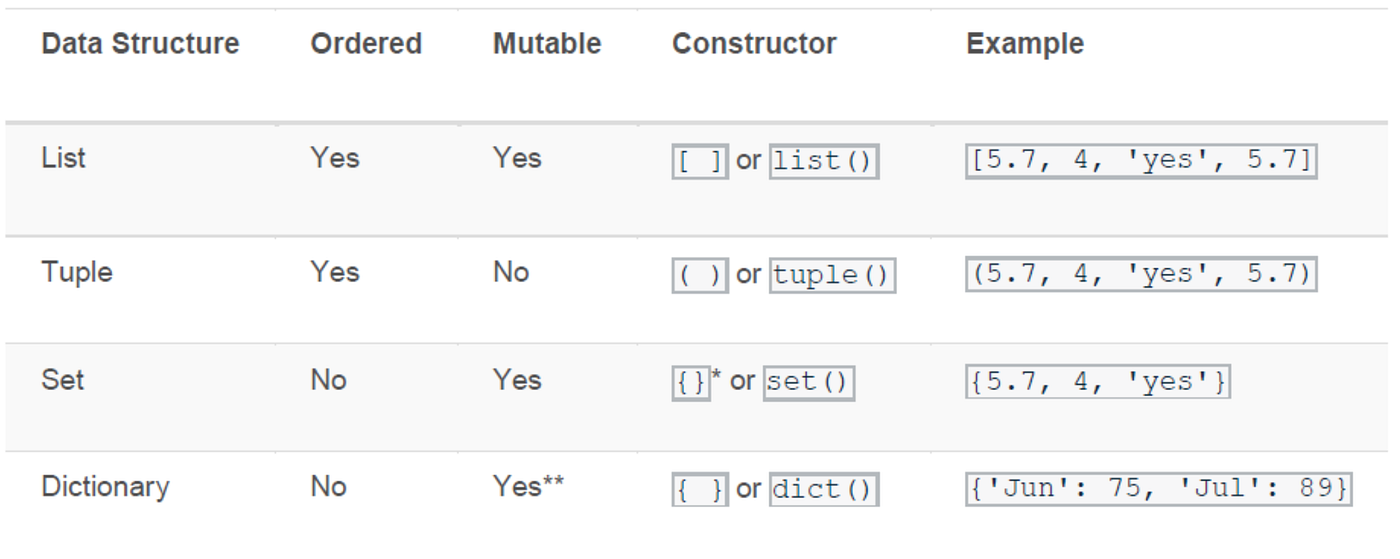
Data Structures and Access Patterns
Choosing the right data structure affects performance.
For example:
- Lists allow fast append operations.
- Dictionaries provide average constant-time lookups.
- Sets enable efficient membership testing.
In analytics pipelines, selecting appropriate structures can prevent unnecessary computational overhead.
For example, checking membership in a list is O(n), but in a set is approximately O(1).
Small design choices accumulate into significant performance differences.
Parallelism and Hardware Awareness
Modern systems often have multiple CPU cores.
Some libraries automatically leverage parallel processing. Others require explicit configuration.
While this course does not delve deeply into distributed systems, it is important to understand:
- Some operations are CPU-bound.
- Some are memory-bound.
- Some can be parallelized effectively.
Understanding bottlenecks helps you diagnose slow systems.
When Premature Optimization Is Harmful
Efficiency is important—but premature optimization can reduce readability and introduce complexity.
The typical workflow is:
- Write clear, correct code.
- Measure performance.
- Optimize bottlenecks only.
Profiling tools help identify slow sections.
Optimization without measurement often wastes effort.
Practical Guidelines for Analysts
To maintain efficient analytical code:
- Prefer vectorized operations over loops.
- Avoid nested loops on large datasets.
- Compute expensive values once.
- Use built-in aggregation functions.
- Be cautious with large temporary objects.
These principles alone dramatically improve scalability.
Efficiency is often about discipline rather than advanced theory.
Connecting Efficiency to the Analytics Lifecycle
Efficiency influences every stage of analytics:
- Data ingestion must scale.
- Cleaning pipelines must process large batches.
- Feature engineering must avoid redundant work.
- Model training must complete within acceptable time windows.
As datasets grow, inefficient code becomes a bottleneck.
Computational awareness transforms you from a script writer into a system designer.
Conceptual Summary
Computational efficiency rests on three pillars:
- Understanding how runtime scales with input size.
- Writing code that minimizes unnecessary operations.
- Leveraging optimized libraries instead of manual loops.
Efficiency is not merely a technical detail—it directly affects feasibility, cost, and reliability.
Next Page
In the next section, we will move into Probability Foundations for Data Analytics.
While computational efficiency ensures that systems scale, probability provides the theoretical framework for reasoning under uncertainty. Together, they form the backbone of modern data science.
You are now transitioning from computational performance to mathematical reasoning.