A Deep Dive into the Future of Intelligence
In the rapidly evolving world of technology, few concepts are as exciting—and as transformative—as Quantum AI. This emerging field represents the convergence of two groundbreaking domains: quantum computing and artificial intelligence (AI). Each of these technologies, on its own, has already begun reshaping industries, redefining innovation, and expanding the boundaries of what machines can achieve. Together, they promise something even more profound—a paradigm shift in how we process information, solve problems, and understand reality itself.
Artificial intelligence has become a cornerstone of modern computing. From recommendation systems and voice assistants to autonomous vehicles and medical diagnostics, AI systems excel at identifying patterns, learning from data, and making decisions. However, despite its impressive capabilities, classical AI is still constrained by the limitations of traditional computing systems.
This is where quantum computing enters the picture.
Quantum computing leverages the principles of quantum mechanics—the science that governs the behavior of particles at the smallest scales. Unlike classical computers, which process information using binary bits (0s and 1s), quantum computers use quantum bits, or qubits, that can exist in multiple states simultaneously. This unique property opens the door to extraordinary computational power.
When AI meets quantum computing, the result is Quantum AI—a powerful hybrid capable of tackling problems that were once considered unsolvable or impractical.
Think of it as AI operating on an entirely new level—faster, more adaptive, and capable of exploring vast possibilities simultaneously.
🌟 Think of it as AI on quantum steroids. Faster, smarter, and capable of exploring massive possibilities all at once.
Understanding the Core Concept
To truly appreciate Quantum AI, it’s important to first understand the fundamental difference between classical and quantum computing.
Classical computers rely on bits, which can only be in one of two states: 0 or 1. Every operation performed by a classical computer is ultimately built on these binary decisions. While modern systems are incredibly fast, they still process tasks in a largely sequential or limited parallel manner.
Quantum computers, on the other hand, use qubits. These qubits have two defining properties:
- Superposition: A qubit can exist as 0, 1, or both at the same time.
- Entanglement: Qubits can become interconnected such that the state of one instantly influences the state of another, regardless of distance.
Because of these properties, quantum computers can process an enormous number of possibilities simultaneously—a phenomenon known as quantum parallelism.
When this computational capability is applied to artificial intelligence, several advantages emerge:
Quantum AI systems can evaluate multiple potential outcomes at once, allowing them to learn faster and more efficiently. They can uncover patterns in highly complex datasets that would overwhelm classical systems. Moreover, they can naturally handle uncertainty and probabilistic scenarios, which are often at the core of real-world problems.
In essence, Quantum AI doesn’t just make AI faster—it fundamentally changes how AI approaches problems.
Why Quantum AI Matters
Despite the remarkable progress in artificial intelligence, classical systems face inherent limitations. As datasets grow larger and problems become more complex, traditional approaches begin to struggle. Training advanced machine learning models can take days or even weeks, requiring enormous computational resources.
Quantum AI addresses these challenges by introducing a new computational framework.
Consider the following areas where Quantum AI offers significant advantages:
- High-dimensional data processing: Classical systems often struggle with data that has many variables or dimensions. Quantum AI can explore vast solution spaces simultaneously, making it better suited for such challenges.
- Complex optimization problems: Tasks like route planning, resource allocation, and financial modeling involve finding the best solution among countless possibilities. Quantum algorithms, such as quantum annealing, can identify optimal solutions more efficiently.
- Pattern recognition: By leveraging quantum interference and entanglement, Quantum AI can enhance pattern detection in ways that classical systems cannot.
- Probabilistic modeling: Many real-world problems involve uncertainty. Quantum systems naturally operate in probabilistic states, making them well-suited for modeling such scenarios.
- Neural network training: Training deep learning models involves adjusting millions or billions of parameters. Quantum approaches have the potential to accelerate this process significantly.
The result is a powerful combination: faster insights, more accurate predictions, and the ability to tackle problems at a scale previously unimaginable.
A Simple Analogy
To better understand the difference between classical AI and Quantum AI, imagine you are searching for a needle in a haystack.
A classical AI system approaches this problem methodically. It examines one straw at a time, quickly but sequentially, until it finds the needle.
A Quantum AI system, however, takes a radically different approach. By leveraging superposition, it effectively evaluates all possible positions of the needle at once. Instead of checking each straw individually, it identifies the most probable locations instantly.
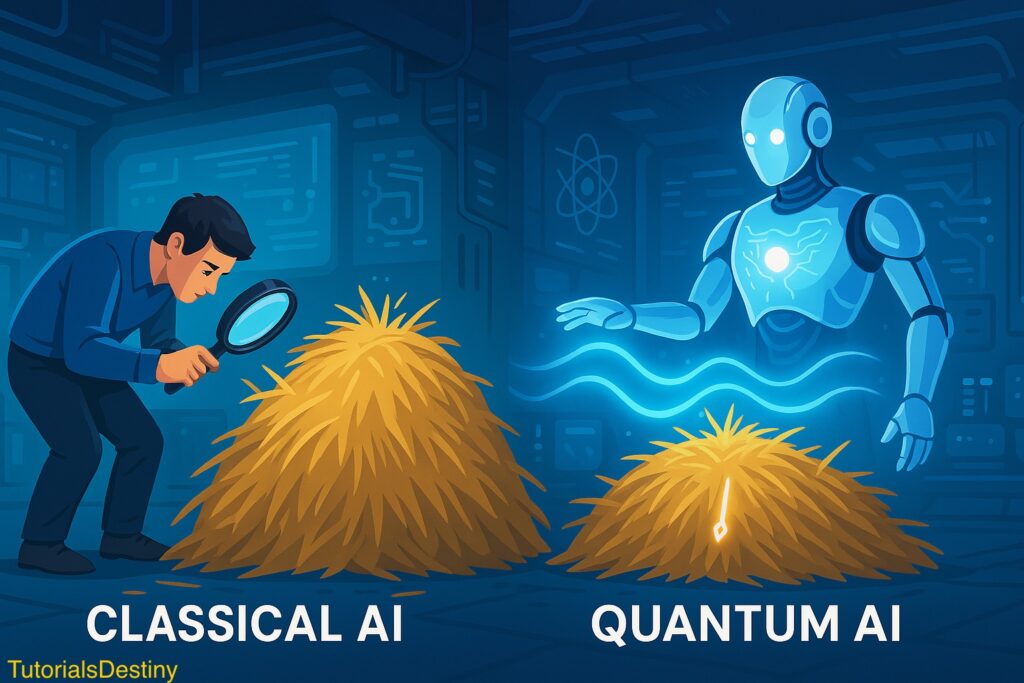
This doesn’t mean Quantum AI magically “knows” the answer, but it dramatically reduces the time required to arrive at it.
This analogy highlights the key advantage of Quantum AI: the ability to explore many possibilities simultaneously rather than sequentially.
Real-World Applications of Quantum AI
Although Quantum AI is still in its early stages, it is already being explored in several high-impact domains. Researchers and organizations around the world are actively experimenting with quantum-enhanced algorithms to solve real-world problems.
Healthcare and Drug Discovery
In healthcare, Quantum AI has the potential to revolutionize how we discover and develop new medicines. Simulating molecular interactions is an incredibly complex task, often requiring immense computational power.
Quantum systems can model these interactions more accurately, enabling:
- Faster drug discovery
- Improved understanding of genetic structures
- Advanced protein folding predictions
These capabilities could lead to breakthroughs in treating diseases that currently have limited or no effective therapies.
Finance and Risk Management
The financial sector deals with vast amounts of data and highly complex models. Quantum AI can enhance financial decision-making by:
- Optimizing investment portfolios in real time
- Improving risk analysis and forecasting
- Detecting fraudulent patterns more efficiently
By processing multiple market scenarios simultaneously, Quantum AI systems can provide deeper insights and more robust strategies.
Cybersecurity
As digital threats become more sophisticated, traditional security measures are increasingly challenged. Quantum AI introduces new possibilities in cybersecurity:
- Quantum cryptography for highly secure communication
- AI-driven threat detection with enhanced accuracy
- Faster identification of vulnerabilities in systems
While quantum computing also poses risks to current encryption methods, it simultaneously offers solutions for building more secure systems.
Climate Science and Environmental Modeling
Understanding and predicting climate behavior involves analyzing complex systems with countless interacting variables. Quantum AI can:
- Model climate systems with greater precision
- Improve long-term forecasting accuracy
- Optimize strategies for reducing environmental impact
These advancements are critical in addressing global challenges such as climate change.
Logistics and Supply Chain Optimization
From delivery networks to global supply chains, logistics involves solving intricate optimization problems. Quantum AI can significantly improve efficiency by:
- Identifying optimal delivery routes
- Reducing fuel consumption and operational costs
- Enhancing real-time decision-making in dynamic environments
This can lead to faster deliveries, lower costs, and more sustainable operations.
Industry Leaders Driving Quantum AI
Several major technology companies and research institutions are actively investing in Quantum AI. These organizations are pushing the boundaries of what is possible and accelerating the development of practical applications.
Companies such as Google, IBM, Microsoft, D-Wave Systems, and Xanadu are leading the charge. They are building quantum hardware, developing software frameworks, and collaborating with researchers to unlock the full potential of this technology.
Their efforts are not just theoretical—they are laying the groundwork for real-world Quantum AI systems that could soon become part of everyday life.
How Quantum AI Works
At a high level, the process of Quantum AI involves several key steps:
- Data Encoding: Large datasets are transformed into quantum states that can be processed by a quantum computer.
- Quantum Processing: Quantum gates manipulate these states using superposition and entanglement, enabling simultaneous exploration of multiple possibilities.
- AI Algorithm Integration: Quantum-enhanced machine learning algorithms analyze the processed data to extract patterns and insights.
- Measurement and Output: The quantum system is measured, collapsing the superposition into a definite result that can be interpreted and used.
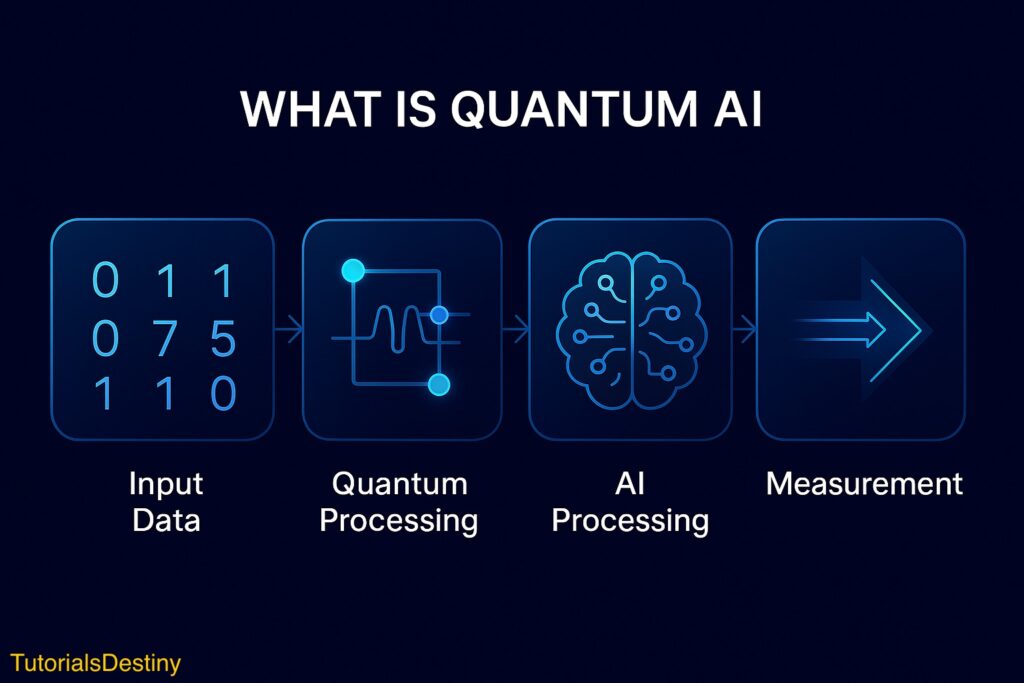
This process can dramatically outpace classical deep learning methods.
This workflow allows Quantum AI systems to process information in fundamentally new ways, often achieving results much faster than classical approaches.
Challenges and Limitations
While the promise of Quantum AI is immense, it is important to acknowledge that the field is still in its early stages. Several challenges remain:
- Hardware limitations: Current quantum computers are still experimental and prone to errors.
- Scalability issues: Building large-scale, stable quantum systems is a significant engineering challenge.
- Algorithm development: Many quantum algorithms are still being researched and refined.
- Accessibility: Quantum technology is not yet widely available for everyday use.
Despite these challenges, progress is being made rapidly, and breakthroughs are occurring at an increasing pace.
The Future of Quantum AI
Looking ahead, Quantum AI has the potential to redefine entire industries. As quantum hardware improves and algorithms become more sophisticated, we can expect:
- Faster and more accurate AI models
- Breakthroughs in scientific research
- Smarter decision-making systems across industries
- New applications that we have yet to imagine
In the long term, Quantum AI could even lead to new ways of understanding intelligence itself—both artificial and natural.
“Quantum AI is not just about faster computing — it’s about a smarter, deeper understanding of data and reality.”
— Quantum AI Research Lab, MIT
Summary
Quantum AI represents the fusion of quantum computing and artificial intelligence into a powerful new paradigm.
It enables machines to process information more efficiently, explore vast solution spaces, and solve problems that were previously out of reach. From healthcare and finance to cybersecurity and climate science, its potential applications are vast and transformative.
Although still in its early stages, Quantum AI is already making significant strides. With continued research and development, it is poised to become one of the most important technological advancements of the 21st century.
What Comes Next?
Now that you have a strong understanding of what Quantum AI is, the next step is to explore how it compares to classical AI in detail.
In the next lesson, you’ll discover the key differences, strengths, and limitations of both approaches—and where Quantum AI truly stands apart.
👉 Continue to: Classical AI vs Quantum AI