Building Smarter Networks Through Better Architecture
In the previous lesson, we explored the foundations of artificial neural networks and discovered how neurons work together to solve complex problems. We learned that neural networks consist of interconnected layers of neurons, each transforming information before passing it to the next layer. We also introduced activation functions and saw how they enable networks to model complex, non-linear relationships.
While these concepts explain how an individual neuron operates, they only reveal part of the story. An equally important question remains:
How should thousands—or even millions—of neurons be organized to solve real-world problems effectively?
The answer lies in deep learning architecture.
Just as the blueprint of a building determines its strength, functionality, and appearance, the architecture of a neural network determines how efficiently it can learn patterns from data. Two neural networks may contain the same number of neurons, yet produce vastly different results simply because they are arranged differently.
Over the years, researchers have designed numerous neural network architectures, each optimized for specific types of data and tasks. Some architectures excel at recognizing objects in images, while others are designed to understand human language, generate realistic artwork, translate text between languages, or even drive autonomous vehicles.
In this lesson, we will explore the principles behind these architectures. Rather than focusing immediately on advanced models like Convolutional Neural Networks (CNNs) or Transformers, we’ll first understand the design philosophy that makes deep learning so powerful. By the end of this lesson, you’ll appreciate why architecture is one of the most critical decisions when building an AI system.
Why Neural Network Architecture Matters
Imagine asking a team of people to solve a complicated engineering problem. If everyone communicates randomly without any organization, confusion quickly follows. However, if responsibilities are divided into logical stages—research, planning, design, testing, and implementation—the team becomes significantly more effective.
Neural networks work in much the same way. Instead of every neuron attempting to learn everything simultaneously, neurons are organized into layers, each responsible for extracting increasingly meaningful information. This organized structure enables the network to gradually transform raw input data into useful knowledge.
Consider an image recognition system designed to identify dogs.
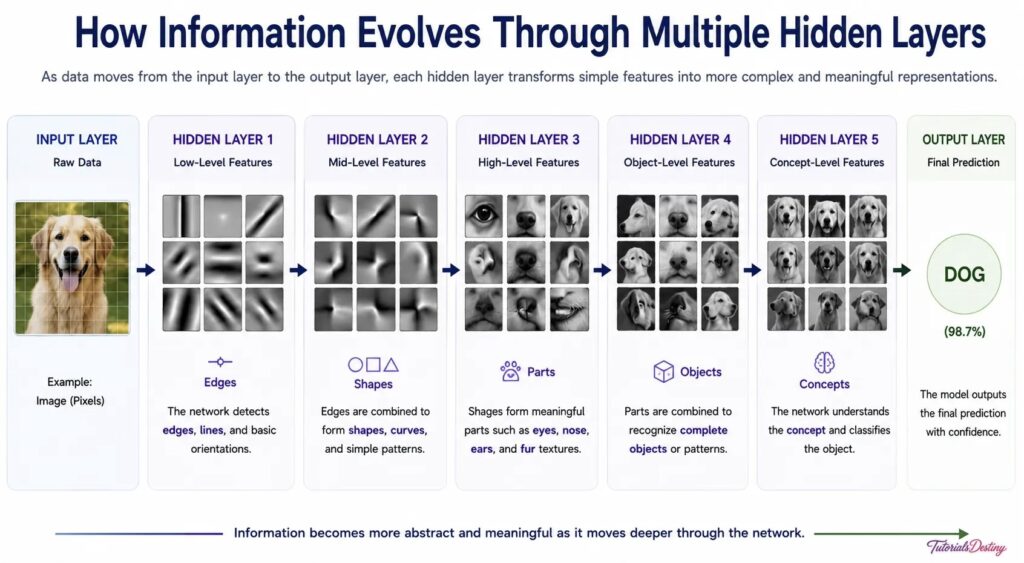
The network doesn’t instantly recognize a dog from raw pixel values. Instead, learning happens progressively:
- The first layers identify simple edges and lines.
- Middle layers combine these edges into shapes such as ears, eyes, and whiskers.
- Deeper layers recognize complete facial structures.
- The final layers determine that these features collectively represent a dog.
Each layer builds upon the understanding developed by the previous one, allowing the network to solve problems that would otherwise be impossible using a shallow architecture.
This gradual refinement of information is one of the defining characteristics of deep learning.
From Shallow Learning to Deep Intelligence
Early neural networks typically contained only one hidden layer. While these models could solve relatively simple tasks, they struggled with problems involving images, speech, language, or highly complex patterns.
Researchers soon realized that simply increasing the number of neurons within a single layer wasn’t enough. Instead, adding multiple hidden layers allowed networks to learn richer and more abstract representations of data.
This observation marked the beginning of the deep learning revolution.
The term “deep” does not refer to the size of a network or the amount of data it processes. Instead, it describes the presence of multiple hidden layers between the input and output layers.
Each additional layer provides another opportunity for the network to refine and reinterpret the information it receives. As data moves deeper through the network, simple features gradually combine into increasingly sophisticated concepts.
This layered learning process enables deep neural networks to tackle tasks that once seemed impossible for machines, such as understanding natural language, recognizing faces, generating realistic images, and playing complex strategy games.
Understanding this transition from shallow to deep learning is essential before examining specific network architectures.
From Layers to Learning: Understanding Feedforward Neural Networks
The true strength of deep learning lies not only in individual neurons but also in how those neurons are organized. A carefully designed architecture allows information to flow efficiently, enabling the network to learn increasingly meaningful representations of data.
To appreciate how modern deep learning models work, it is helpful to begin with the simplest and most fundamental architecture: the Feedforward Neural Network (FNN).
Although today’s AI systems often use sophisticated architectures such as Convolutional Neural Networks (CNNs), Recurrent Neural Networks (RNNs), and Transformers, they all build upon principles first introduced by feedforward networks.
Understanding this architecture provides the conceptual foundation needed for every advanced deep learning model you will encounter later in this course.
The Birth of Feedforward Neural Networks
As researchers experimented with artificial neurons, they quickly realized that a single neuron had very limited capabilities. It could solve only relatively simple problems, such as making a binary decision or separating data with a straight-line boundary.
Real-world problems, however, are far more complicated. Recognizing a handwritten digit, identifying objects in a photograph, or understanding spoken language requires thousands—or even millions—of small computations working together.
The natural solution was to connect many artificial neurons into layers, allowing information to flow from one layer to the next. This arrangement became known as the Feedforward Neural Network, or FNN.
The word feedforward describes the direction of information flow. Data always moves forward, starting at the input layer and progressing through one or more hidden layers until it reaches the output layer. Unlike some advanced architectures, there are no loops or cycles that send information backward during prediction.
This simple design became the foundation of modern neural networks and remains one of the most widely studied architectures in artificial intelligence.
What Is a Feedforward Neural Network?
A Feedforward Neural Network is the simplest type of artificial neural network in which information moves in only one direction—from input to output.
The network is organized into distinct layers:
- Input Layer – Receives the raw data.
- Hidden Layer(s) – Extracts patterns and relationships from the data.
- Output Layer – Produces the final prediction.
Each neuron in one layer is connected to neurons in the following layer, creating a structured pathway through which information flows.
Unlike the human brain, where signals may travel in many directions, a feedforward network follows a straightforward sequence. Once information moves to the next layer, it does not return to the previous one during prediction.
This simplicity makes feedforward networks easier to understand and serves as the basis for many more advanced architectures.
Understanding Information Flow
To better understand a feedforward network, imagine an assembly line in a manufacturing plant.
At the beginning of the line, raw materials enter the factory. As they move through different stations, each station performs a specific task—cutting, shaping, assembling, polishing, or testing. By the time the product reaches the final station, it has been transformed into a finished item.
A feedforward neural network works in much the same way.
The input layer receives raw data, such as pixel values from an image or numerical values from a dataset. The first hidden layer identifies simple patterns within the data. Each subsequent hidden layer builds upon the work of the previous layer, gradually discovering more complex relationships. Finally, the output layer produces the network’s prediction.
Each layer contributes a small part to the overall learning process. Individually, these computations may seem simple, but collectively they enable the network to solve remarkably sophisticated problems.
A Practical Example
Suppose we want to predict whether a customer is likely to purchase a product.
The input layer receives information such as:
- Customer age
- Monthly income
- Previous purchases
- Time spent browsing the website
- Number of products viewed
The first hidden layer might identify relationships between browsing behavior and purchasing habits.
The second hidden layer could combine these relationships to identify buying intent.
The third hidden layer might recognize complex customer profiles based on multiple behavioral patterns.
Finally, the output layer predicts:
- Likely to purchase
- Unlikely to purchase
Notice that no individual neuron understands the entire problem. Each neuron contributes only a small piece of the solution. Together, thousands of neurons collaborate to produce an accurate prediction.
Components of a Feedforward Neural Network
Although feedforward networks can vary greatly in size, they all consist of the same fundamental components.
Input Layer
The input layer serves as the network’s point of entry. Every feature in the dataset corresponds to one input neuron.
For example, consider a house price prediction model.
Input features might include:
- House size
- Number of bedrooms
- Age of the building
- Distance from the city center
- Availability of parking
If the dataset contains five features, the input layer will contain five input neurons.
It is important to note that the input layer does not perform learning. Its sole purpose is to receive and pass information to the next layer.
Hidden Layers
The hidden layers are where the network performs most of its learning.
Unlike the input and output layers, hidden layers do not directly interact with the outside world. Instead, they transform information received from previous layers into increasingly meaningful representations.
Consider an image classification problem.
The first hidden layer may learn to detect:
- Horizontal edges
- Vertical edges
- Corners
- Simple textures
The second hidden layer combines these basic features to identify more recognizable shapes.
The third hidden layer may recognize objects such as eyes, wheels, leaves, or windows.
Additional hidden layers combine these object parts into complete concepts like cars, dogs, or human faces.
The output layer is responsible for producing the network’s final prediction. The number of output neurons depends entirely on the problem being solved.
For example:
Binary Classification
A spam detection system may contain a single output neuron representing the probability that an email is spam.
Multi-Class Classification
An animal recognition system may contain multiple output neurons representing different animal categories.
Regression
A house price prediction model may contain one output neuron representing the predicted price.
Although the output layer appears simple, its prediction reflects the combined work of every neuron in the network.
Fully Connected (Dense) Layers
One of the defining characteristics of traditional feedforward networks is the use of fully connected, or dense, layers.
In a dense layer, every neuron is connected to every neuron in the following layer.
This means each neuron receives information from all neurons in the previous layer before performing its own computation.
Imagine a classroom discussion where every student can communicate with every student in the next group. Information flows freely, allowing each participant to consider all available inputs before making a decision.
Similarly, a dense layer allows every neuron to access the complete set of features generated by the previous layer.
Because every neuron receives information from all neurons in the previous layer, dense layers can learn highly complex relationships.
For example, when predicting customer behavior, a neuron might simultaneously consider:
- Age
- Income
- Purchase history
- Geographic location
- Device type
- Website activity
Rather than evaluating each feature independently, the neuron learns how these features interact with one another.
This ability to model complex relationships makes dense layers extremely powerful for many prediction tasks.
The Cost of Full Connectivity
While dense layers offer great flexibility, they also require a large number of parameters.
Imagine connecting:
- 500 neurons in one layer
- to 1,000 neurons in the next layer.
This single connection creates 500,000 individual weights.
If additional layers are added, the number of parameters grows rapidly.
Large parameter counts increase:
- Memory usage
- Training time
- Computational requirements
- Risk of overfitting
These limitations motivated researchers to develop more efficient architectures, such as Convolutional Neural Networks, which dramatically reduce the number of required parameters.
We will explore these specialized architectures later in this module.
Advantages of Feedforward Neural Networks
Despite their simplicity, feedforward networks remain highly valuable. Some of their major advantages include:
- Easy to understand and implement.
- Strong foundation for learning deep learning concepts.
- Effective for structured and tabular datasets.
- Capable of approximating highly complex mathematical functions.
- Flexible enough to solve classification and regression problems.
For many business applications involving structured numerical data, feedforward networks continue to perform exceptionally well.
Limitations of Feedforward Neural Networks
Although feedforward networks are powerful, they are not the ideal solution for every problem. Their primary limitations include:
- They do not remember previous inputs, making them unsuitable for sequential data.
- They require large numbers of parameters as networks grow deeper.
- They cannot efficiently exploit spatial relationships within images.
- They often demand significant computational resources for large-scale problems.
These limitations inspired researchers to design specialized architectures capable of handling images, text, speech, and time-series data more effectively.
Understanding these shortcomings helps explain why modern AI relies on multiple neural network architectures rather than a single universal design.
Bridging to Deeper Architectures
At this stage, we have explored how feedforward neural networks are organized, how information flows through them, and why dense layers play such an important role in learning.
However, another fascinating question naturally arises.
If simply connecting neurons together enables a network to solve complex problems, why do some neural networks contain dozens, hundreds, or even thousands of layers?
The answer lies in a concept known as representation learning—the ability of deep networks to automatically discover increasingly abstract features as information moves through successive layers.
From Learning Features to Understanding the World
In the previous part, we explored how Feedforward Neural Networks organize neurons into layers and how information moves from the input layer to the output layer. We also learned why dense layers are powerful and how increasing the number of layers allows networks to solve more complex problems.
However, we have only scratched the surface of what makes deep learning remarkable.
A fundamental question still remains:
How do deep neural networks automatically learn meaningful features without human intervention?
Traditional Machine Learning often depends on carefully crafted features created by domain experts. Deep Learning takes a completely different approach. Instead of asking humans to tell the model what to look for, deep neural networks learn the most useful features directly from data.
This ability, known as representation learning, is one of the greatest breakthroughs in Artificial Intelligence.
In this final part of the lesson, we’ll explore how representation learning works, compare deep and wide networks, examine the major families of deep learning architectures, and learn how engineers choose the right architecture for different AI applications.
Representation Learning: Letting the Network Discover Features
One of the biggest challenges in traditional Machine Learning is deciding which features should be used for prediction.
Consider building a model that recognizes handwritten digits.
A traditional approach might require engineers to manually define features such as:
- Number of corners
- Number of closed loops
- Width-to-height ratio
- Stroke thickness
- Edge orientations
Designing these features requires significant expertise, and there’s no guarantee that the chosen features are the most informative.
Deep Learning eliminates much of this manual effort.
Instead of relying on handcrafted features, the network automatically discovers useful representations while training. This process is known as representation learning.
Rather than being told what makes a digit, face, or object unique, the network gradually learns these characteristics by analyzing thousands—or even millions—of examples.
This ability to learn directly from raw data is one of the primary reasons deep learning has surpassed traditional Machine Learning in many complex domains.
Learning Features Layer by Layer
One of the most remarkable capabilities of deep neural networks is their ability to learn features progressively. Rather than identifying an object in a single step, a neural network builds its understanding gradually as information passes through successive hidden layers. Each layer transforms the output of the previous layer into a richer and more meaningful representation, enabling the network to recognize increasingly complex patterns.
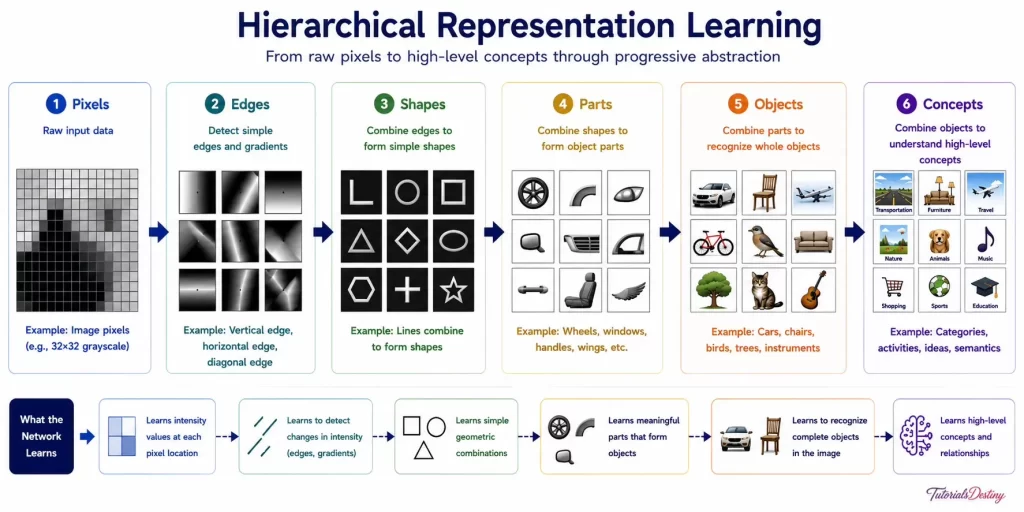
Consider an image containing a car, a bird, a tree, or a chair. At the beginning of the learning process, the network has no understanding of these objects. It only receives the image as a collection of numerical pixel values. During training, the hidden layers work together to transform these raw pixels into meaningful concepts through a hierarchical learning process.
Stage 1: Pixels – Receiving the Raw Input
The learning journey begins with the raw pixels of the image. Every image is represented as a grid of numerical values that describe the intensity or color of each pixel.
At this stage, the network has no knowledge of objects or patterns. It simply receives the raw input data and learns the intensity values at each pixel location.
Stage 2: Edges – Detecting Basic Visual Features
As the image passes through the first hidden layer, the network begins identifying simple visual features by detecting changes in pixel intensity.
These low-level features include:
- Horizontal edges
- Vertical edges
- Diagonal edges
- Intensity gradients
Although these features are very simple, they form the foundation for recognizing more complex structures later in the network.
Stage 3: Shapes – Combining Edges into Geometric Patterns
The next hidden layers combine multiple edges to form simple geometric shapes.
Instead of viewing isolated lines, the network begins recognizing patterns such as:
- Circles
- Squares
- Triangles
- Curves
- Crosses
- Polygons
These geometric combinations provide a more meaningful representation of the image and serve as the building blocks for identifying object components.
Stage 4: Parts – Learning Meaningful Object Components
As information moves deeper into the network, neurons begin combining geometric shapes into recognizable parts of real-world objects.
Depending on the image, the network may identify components such as:
- Wheels
- Windows
- Door handles
- Side mirrors
- Wings
- Seats
At this stage, the network is no longer analyzing simple shapes. Instead, it is learning meaningful parts that frequently appear in different objects.
Stage 5: Objects – Recognizing Complete Objects
After learning individual object components, deeper layers combine these parts into complete object representations.
The network can now recognize entire objects such as:
- Cars
- Chairs
- Airplanes
- Bicycles
- Birds
- Trees
- Cats
- Sofas
- Musical instruments
Rather than identifying isolated wheels or windows, the model understands how these components fit together to form complete objects.
Stage 6: Concepts – Understanding High-Level Meaning
The deepest hidden layers move beyond recognizing individual objects and begin learning higher-level semantic concepts.
Instead of seeing only a car or a tree, the network groups objects into broader categories such as:
- Transportation
- Furniture
- Travel
- Nature
- Animals
- Music
- Shopping
- Sports
- Education
These high-level concepts allow the network to understand relationships between different objects and support advanced AI applications such as image classification, scene understanding, semantic search, recommendation systems, and visual reasoning.
The progression from Pixels → Edges → Shapes → Parts → Objects → Concepts illustrates the essence of hierarchical representation learning. Each hidden layer builds upon the knowledge acquired by the previous layer, transforming raw numerical data into increasingly abstract and meaningful representations. This layered approach enables deep neural networks to understand complex visual information and is one of the key reasons behind their outstanding performance in computer vision, image recognition, autonomous driving, medical imaging, and many other real-world AI applications.
Why Representation Learning Changed AI
The ability to automatically learn representations transformed the field of Artificial Intelligence.
Instead of designing hundreds of handcrafted rules, engineers could simply provide:
- Large datasets
- Powerful hardware
- Well-designed neural network architectures
The network itself would discover the features needed for the task.
This breakthrough accelerated progress across numerous AI fields, including:
- Computer Vision
- Natural Language Processing
- Speech Recognition
- Medical Imaging
- Robotics
- Recommendation Systems
Many modern AI systems owe their success to representation learning.
Deep Networks vs. Wide Networks
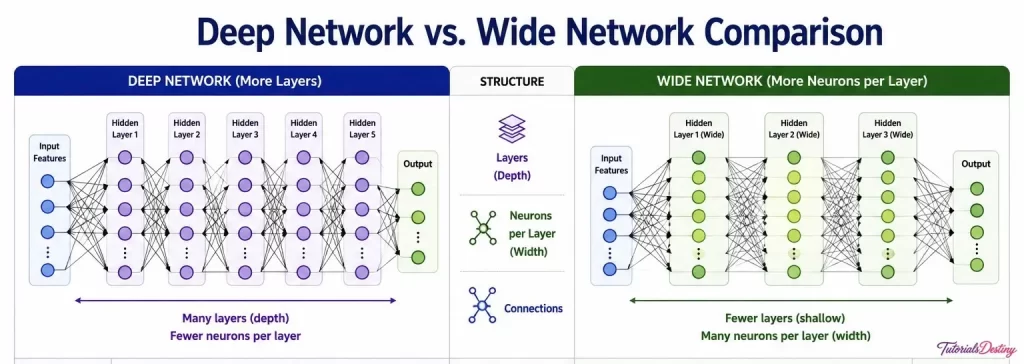
As neural networks evolved, researchers explored two primary ways to increase model capacity:
- Making networks deeper.
- Making networks wider.
Although both approaches increase learning capability, they do so in different ways.
What Is a Deep Network?
A deep network contains many hidden layers. Each layer builds upon the features extracted by previous layers, allowing the model to learn increasingly abstract concepts.
Each additional layer provides another opportunity to refine the learned representation.
Deep networks excel at tasks involving complex hierarchical patterns, such as image recognition and language understanding.
What Is a Wide Network?
A wide network contains fewer hidden layers but significantly more neurons within each layer
Wide networks increase computational capacity within individual layers rather than increasing depth.
They are often useful for structured datasets where extremely deep hierarchies are unnecessary.
Comparing Deep and Wide Networks
| Feature | Deep Network (More Layers) | Wide Network (More Neurons per Layer) |
|---|---|---|
| Structure | Many hidden layers with fewer neurons per layer | Fewer hidden layers with many neurons per layer |
| Representation Learning | Learns hierarchical representations step-by-step. Builds complex features from simple to more abstract. | Learns at the same level of abstraction. All features are combined at once. |
| Strengths | Excels at capturing complex patterns and hierarchies. More parameter-efficient for many tasks. Often generalizes better with enough data. | Can model complex functions with fewer layers. May train faster on simple/medium complexity tasks. Effective when relationships are mostly at the same level. |
| Challenges | Harder to train (vanishing/exploding gradients, etc.). Requires careful design and tuning. | Can require a very large number of neurons. More prone to overfitting with limited data. Higher computational and memory cost as width grows. |
| Computational Cost | Lower parameter count for the same representational power (typically). Deeper networks may take longer to train per epoch. | Higher parameter count as width increases. More memory and computation required per layer. |
| Best Suited For | Complex tasks with hierarchical structure (e.g., computer vision, NLP, speech recognition). Large datasets where deep features emerge. | Problems where features are relatively flat or interactions are simple. Situations where faster training per epoch is important and data is limited. |
| Typical Use Cases | Image classification, object detection, language models, speech recognition, deep reinforcement learning | Tabular data, structured business datasets, recommendation systems, simpler regression and classification tasks |
| Key Takeaway | Best for learning progressively richer and more abstract representations through depth. | Best for modeling broad feature interactions within fewer layers by increasing the number of neurons. |
Neither architecture is universally superior.
The best choice depends on the nature of the problem, available data, and computational resources.
Popular Deep Learning Architectures
As AI researchers tackled increasingly diverse problems, they realized that no single neural network architecture could perform optimally in every situation.
Different types of data require different architectural designs.
Let’s briefly examine the most influential deep learning architectures.
Feedforward Neural Networks (FNN)
Feedforward Neural Networks (FNNs), also known as Multilayer Perceptrons (MLPs), are the simplest and most fundamental type of artificial neural network.
In an FNN, information flows in a single direction—from the input layer, through one or more hidden layers, and finally to the output layer.
Unlike recurrent networks, there are no loops or feedback connections, meaning the network has no memory of previous inputs.
Best suited for:
- Structured datasets
- Regression
- Classification
- Business analytics
Convolutional Neural Networks (CNN)
Convolutional Neural Networks (CNNs) are specialized deep learning models designed to process grid-structured data, particularly digital images.
Instead of analyzing every pixel individually, CNNs use convolutional layers that apply small filters (also called kernels) across the input image to identify meaningful features such as edges, textures, corners, and shapes.
These extracted features are then simplified using pooling layers, which reduce the size of the feature maps while preserving the most important information. Finally, fully connected layers combine all the learned features to classify the image or generate the final prediction.
Applications include:
- Face recognition
- Medical imaging
- Autonomous driving
- Satellite imagery
CNNs dramatically reduce the number of parameters while improving image recognition performance.
Recurrent Neural Networks (RNN)
Recurrent Neural Networks (RNNs) are designed for handling sequential data where the order of information is important. They are commonly used in applications involving text, speech, time-series forecasting, and language translation.
Unlike traditional feedforward neural networks, RNNs contain feedback connections that allow information from previous time steps to influence the current prediction.
This internal memory enables the network to capture relationships across a sequence, making it suitable for tasks that require understanding context over time such as:
- Speech
- Text
- Time series
- Financial forecasting
Although many applications now use Transformers, RNNs remain historically significant.
Transformers
The Transformer architecture has transformed the field of Natural Language Processing (NLP) by providing an efficient way to model relationships between words in a sequence. Unlike RNNs,
Transformers process all input tokens simultaneously instead of one step at a time. They rely on a self-attention mechanism, which enables the model to determine the importance of each word relative to every other word in the sequence.
A typical Transformer consists of encoder and decoder blocks, each containing multi-head self-attention layers and feedforward neural networks.
This architecture powers many modern AI systems, including large language models such as ChatGPT, as well as machine translation and text summarization systems.
Transformers power many state-of-the-art AI systems, including:
- ChatGPT
- Google Gemini
- Claude
- Machine Translation
- Text Summarization
Their ability to process information in parallel makes them highly efficient for language tasks.
Autoencoders
Autoencoders learn compact representations of data.
Autoencoders are deep learning architectures primarily used for unsupervised learning and data generation.
An Autoencoder consists of two main components: an encoder, which compresses the input into a compact latent representation, and a decoder, which reconstructs the original data from this compressed form.
Common applications include:
- Data compression
- Noise removal
- Anomaly detection
- Feature extraction
Choosing the Right Architecture
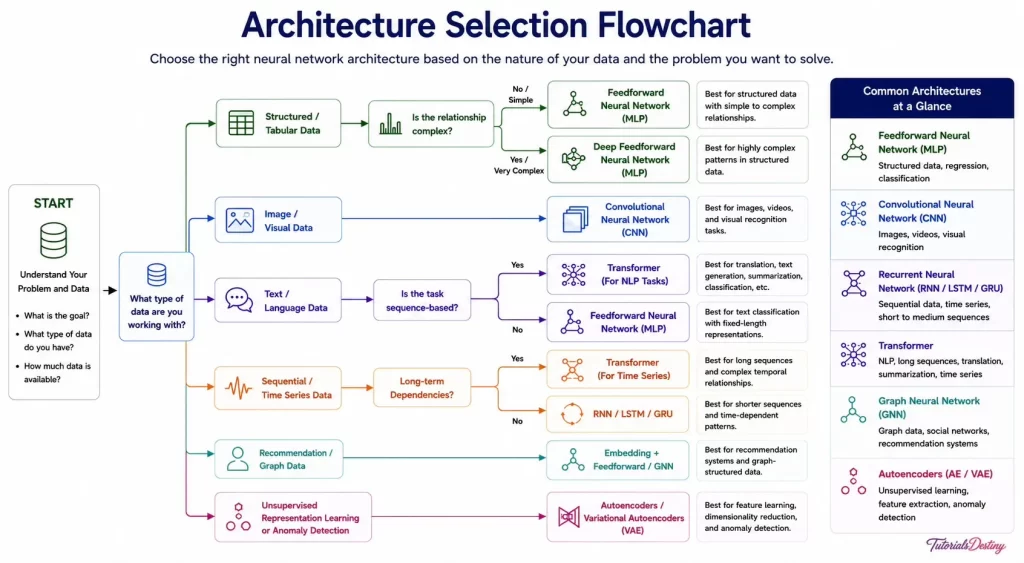
Selecting the appropriate architecture is one of the most important decisions in an AI project.
Different architectures excel at different tasks.
| Problem Type | Recommended Architecture |
| House Price Prediction | Feedforward Neural Network |
| Image Classification | CNN |
| Video Analysis | CNN + Transformer |
| Machine Translation | Transformer |
| Speech Recognition | Transformer |
| Time Series Forecasting | RNN / Transformer |
| Recommendation Systems | Feedforward + Embeddings |
| Medical Imaging | CNN |
Rather than searching for a universal architecture, AI engineers select the one best suited to the characteristics of the data.
Real-World Applications of Deep Learning Architectures
Deep learning architectures are now embedded in countless technologies we use every day.
Healthcare
CNNs help detect diseases from X-rays, CT scans, and MRI images.
Finance
Feedforward networks assist in:
- Credit scoring
- Fraud detection
- Risk assessment
Autonomous Vehicles
Self-driving cars combine multiple architectures to:
- Detect objects
- Recognize road signs
- Track pedestrians
- Plan driving actions
Natural Language Processing
Transformers enable:
- Chatbots
- Language translation
- Question answering
- Text generation
E-commerce
Recommendation systems analyze customer behavior to suggest products likely to interest individual users.
These examples illustrate how choosing the right architecture directly impacts the success of an AI solution.
Advantages of Modern Deep Learning Architectures
Modern architectures offer several significant benefits.
- Automatic feature learning
- Exceptional predictive accuracy
- Scalability to large datasets
- Flexibility across multiple domains
- Ability to model highly complex relationships
These strengths have made deep learning the dominant approach in many areas of Artificial Intelligence.
Challenges and Limitations
Despite their impressive capabilities, deep learning architectures also present challenges.
- Large Data Requirements: Many deep networks require extensive labeled datasets for effective training.
- High Computational Cost: Training large models often demands GPUs or specialized hardware.
- Hyperparameter Tuning: Selecting the right architecture, learning rate, and network size requires experimentation.
- Interpretability: Many deep models function as “black boxes,” making their decisions difficult to explain.
- Energy Consumption: Training very large models can require substantial computational resources and electrical power.
Understanding these limitations helps practitioners choose appropriate solutions and use deep learning responsibly.
Interview Corner
Frequently Asked Questions
1. What is a deep learning architecture?
A deep learning architecture defines how neurons and layers are organized and connected within a neural network.
2. Why are multiple hidden layers important?
They enable hierarchical feature learning, allowing the network to understand increasingly complex patterns.
3. What is representation learning?
Representation learning is the process by which neural networks automatically discover useful features directly from raw data.
4. How is a CNN different from a Feedforward Neural Network?
A CNN uses convolutional filters to efficiently process images, while a feedforward network relies on fully connected layers.
5. Which architecture powers ChatGPT?
ChatGPT is based on the Transformer architecture.
These concepts prepare you for the next critical stage of deep learning: training.
What’s Next?
➡ Module 3 – Lesson 3: Training Deep Neural Networks
In the next lesson, you’ll learn how neural networks improve their predictions through:
- Forward and backward propagation
- Loss functions
- Gradient descent
- Optimizers (SGD, Momentum, RMSProp, Adam)
- Learning rates
- Epochs, batches, and mini-batches
- Weight initialization
- Vanishing and exploding gradients
- Batch normalization and regularization
This lesson will explain the complete training pipeline that enables deep neural networks to learn from data effectively.